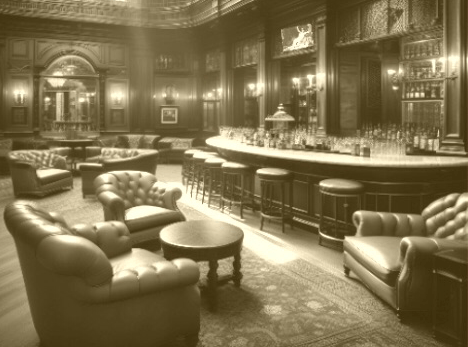
“No woman has ever crossed its threshold,” Bonney had said, and then he’d smirked. “Not even our mayoress.”
“Accomplished” and “Gentlemen” are important, but the true emphasis is on “TRUSTED.”
“No woman has ever crossed its threshold,” Bonney had said, and then he’d smirked. “Not even our mayoress.”
“Accomplished” and “Gentlemen” are important, but the true emphasis is on “TRUSTED.”
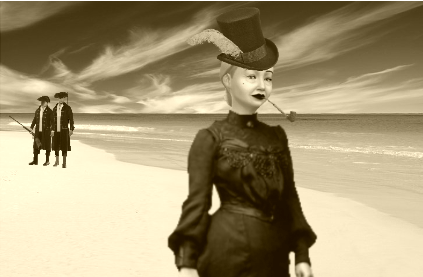
Thirty years before, according to Dr. Teach, Madame had propped the photograph of her dead husband, lit by two candles, up on his vault at Mariner’s Rest the day after his funeral. She then set her desk just inside the tomb’s open doors and conducted business there, flanked by two militia men, as prominent islanders lined up to learn whether or not they remained in favor with the Reckoners. Thus, La Reckoner had cast her husband’s shadow before her and reminded everyone of his will.
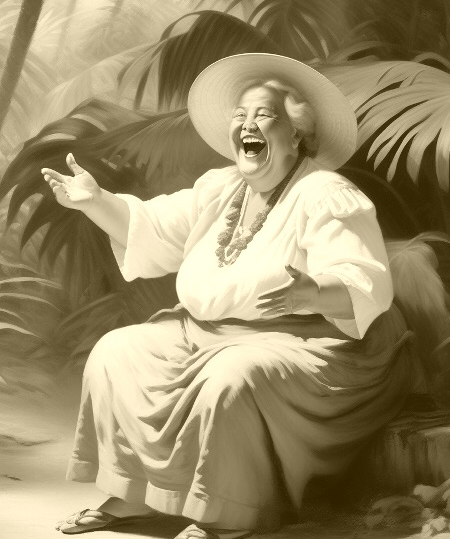
“A man is but a candle-stick
A woman is the holder…”
“The Light in the Cove” is a ribald ballad in English about an old woman lusting after the ghost of a young man. Everyone on the island knows both the melody and the words, though few respectable women or wise children will admit to it.
It was originally a wistful native song called “Elaro.”
But that’s forgotten.
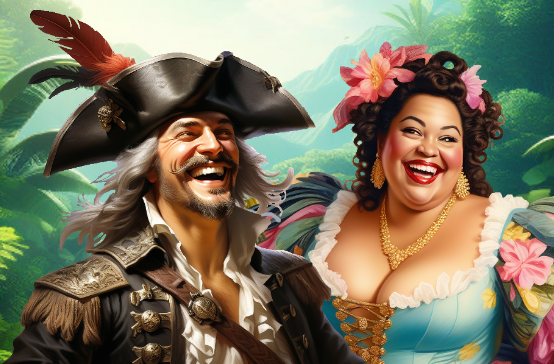
… Longstaffe was a rebellious young aristocrat or a conscience-stricken slaver or a pirate whose brutality and ruthlessness made Henry Morgan himself shake his head in appalled disapproval.
He was hanged for defiling a well or he was slain and eaten by the Tomami or he was slain and eaten by his shipwrecked mates because they were hungry or perhaps just because he was unpopular and they were trying to make a point. Or he became a hopeless drunk and was found dead from Paresis on the sands of Sanctuary Strand.
The only consistent part of his legend is his virility and his paramour, Deep Gertie.
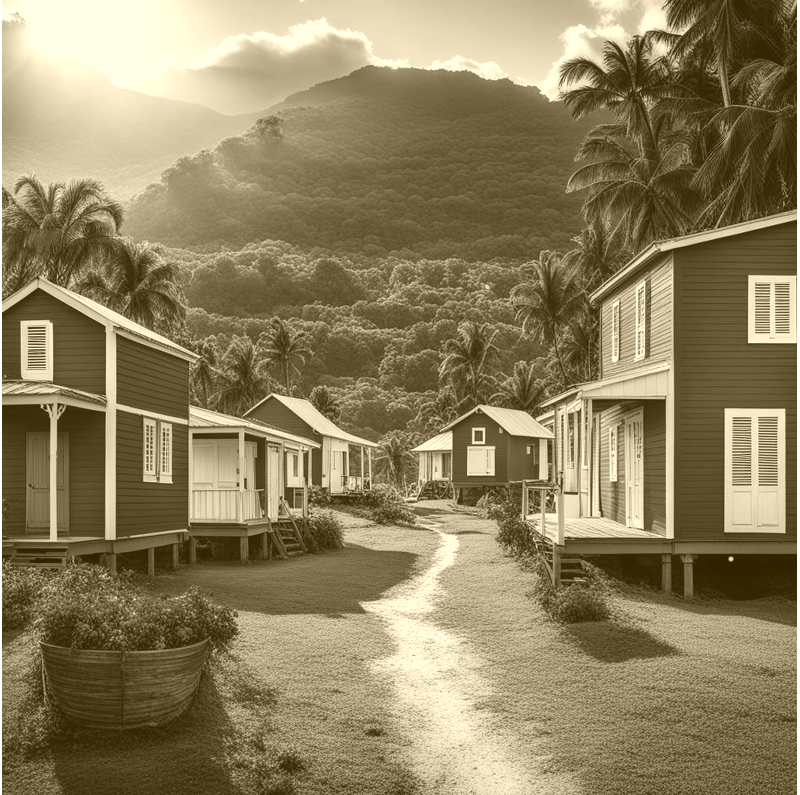
“‘What is this Theodosia?’ demanded Gwennoelle.
‘Why, Madame,’ The man bowed to her slightly. ‘It is a little town on the east side of the island. Very pretty place, with its own market, and lovely cottages, newly built and ready for newcomers like you. It’s where many of our workers live.‘”
The Island Council is especially proud of the “workers’” cottages that cluster around plantations throughout Theodosia, freshly painted in red and white and each with their own small vegetable plot. This housing is prominently pictured and described in advertisements for plantation workers in ports like New Orleans, Naples, and Dublin, their sturdiness and comfort extolled, along with the availability of schooling for children.
The heat, the uncovered cisterns, Yellow Fever, and the houses’ actual tenants are not mentioned.
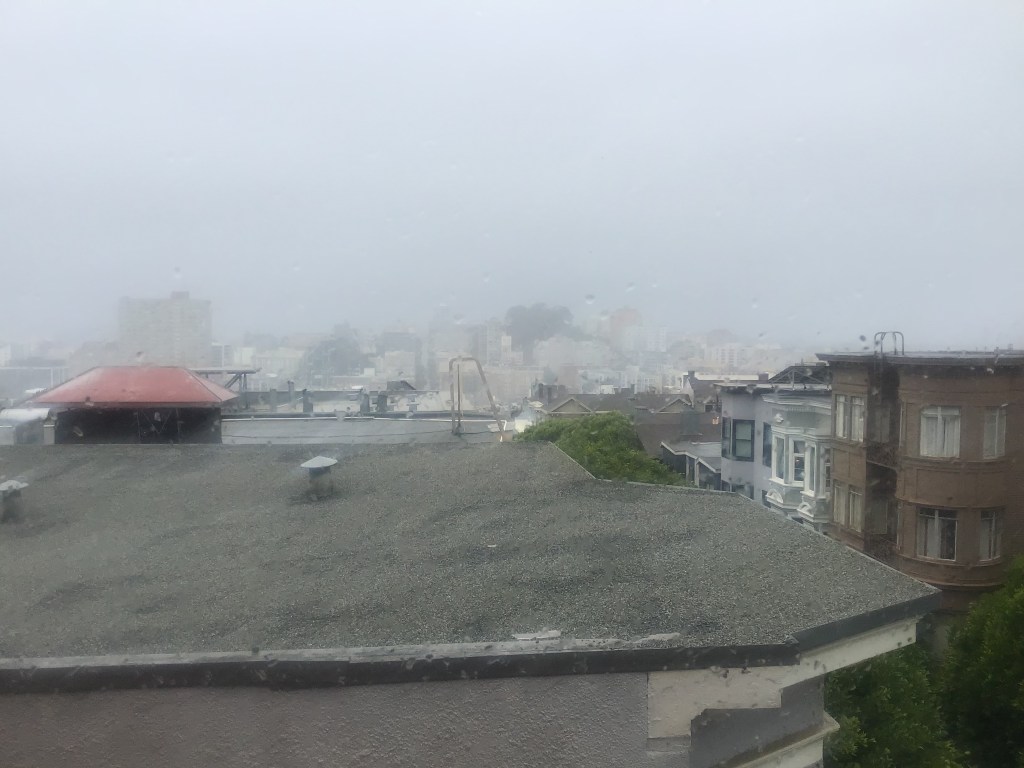
All gray, all wet, the pane spotted with rain, gusts of wind roaring and diving around hills and buildings like invisible, giant, avenging angels. The green treetops just over the roofs nearby thrash and pitch. Thunder rumbles and scrapes (never bangs) overhead. Not many cars are visible on the rising slope of our street blocks away, and the ones approaching have their headlights on, even though its just half past noon. That road, as always during storms, vanishes at its summit into gray nothingness. The Golden Gate Bridge and the Marin headlands have been erased.
Have our reservoirs been replenished?
Whether or not the drought is actually over, rain is no longer a novelty.

“Oh, aye, I see this one around sometimes. One of them Dudays. Things go missing when he turns up.”
Telesphore “Tel” Fortune Duday is not the eldest living Duday child. That would be Laurette, his sister who was born one hour before him in Fourche in 1873. He is, however, their eldest living son, and the one Maman considers the most promising. Her Telesphore is clever and energetic. She likes the way his eyes meet hers when she explains something to him. One can almost hear the ticking of his brain as he thinks. He plainly draws his own conclusions, but he is a wise son, and never contradicts or questions his mother. Once he is fledged and comes into his talent, who knows how far he will go?
Tel’s piercing, fiery-blue gaze will become legendary on the island, and his adult reputation as a sorcerer will surpass his mother’s, though he will be considered much more approachable and engaging than “herself.” He has a broad, humorous smile, and the knack of making the person speaking to him feel like the only person in his world at that moment.
Those who love him will call him “charming.” Those who don’t will call him “insidious.”
But not on television. I can’t think of any sport at all I would specifically tune in to watch on television — unless the Saints or the 49ers are playing in the Superbowl, and even then, the ads are half the fun.
I will, however, in a park or stadium, watch almost any baseball game from beginning to end. The one exception was a game I attended last autumn in Boston where it was raining heavily and the seats were close to the field but at such an angle I had to crane my neck to make out what was happening.
My preferred seating is high up in the bleachers so I can see everything play out below me. Which is why I don’t like watching baseball on TV. I don’t care what the batter looks like, and I don’t want to hear his stats. I don’t want to see a closeup of some young pitcher’s face as his sports career dribbles down the drain when he screws up. I’m not interested in hearing predictions about what the coach is going to do next.
I just want to eat a hot link and sit in the bleachers and watch that big, beautiful dial of a field tick through the innings, while I groan at outs and jump up and yell when someone gets to a base or home.
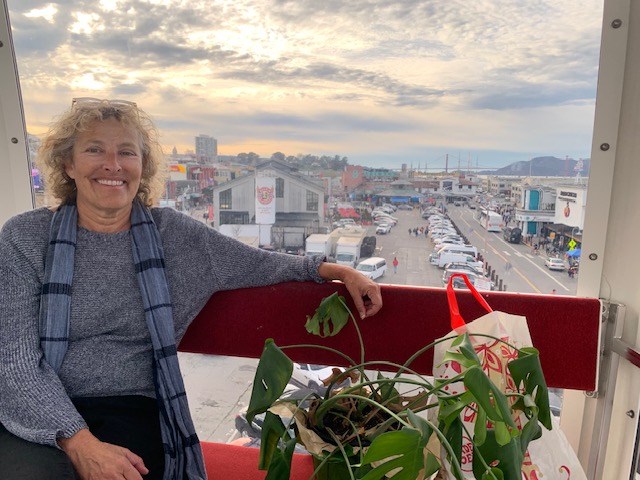
ANDREA AND HER PLANT
Yesterday was gloriously sunny, and at last I took a spin on the Ferris wheel at Fisherman’s Wharf. SkyStar, it’s called. It used to be in Golden Gate Park, but I think this location is far better, more in the thick of things.
A friend I met along the way came along. The Ferris wheel has become a landmark visible from quite a distance, so we simply walked down the hill towards it, my friend pausing to rescue a bedraggled Elephant Ear plant she found abandoned on a curb. Nobody, either in the line for tickets, or the line to board, commented on the drooping potted plant she held in her arms. “Everyone assumes old women are crazy anyway,” was her explanation.
The cars are small, enclosed, glassy lozenges rather than open, rocking benches in the sky, which I would have found more thrilling. I suppose it’s a question of both safety and comfort. The winds off the bay can be pretty cold. We took our seats, and began to rise slowly, pausing as each car was loaded. Once everyone had boarded the wheel turned, steadily, slowly, rising, offering views of Fisherman’s Wharf and the Bay, downtown San Francisco, and a beautiful mackeral sky rippled with clouds glowing in the afternoon sun. If I looked over my shoulder I could see Pier 39, dark with crowds, the sea-lions, who seemed shy that day, a little black clump on the corner of one of the docks.
The wheel rotates three times after loading, very slowly, with a minimum of rocking. For San Francisco residents our age, it’s quite reasonably priced, though they did take our picture and try to sell it to us for $46. We politely declined.
My friend walked home with her new pet. I plunged into North Beach in search of a cafe that sold wine by the glass. The one I found was cash-only, so I settled for a bar, the Comstock, where I sat at a little marble table, happily sipping a rose and alternately reading a novel and the latest New Yorker. I haven’t enjoyed reading so much since the days when I would curl up on my parents’ couch with a book and a plate of bacon sandwiches.
We would have two houses. One in the San Francisco Bay area, the other in the North Carolina Mountains. Maybe Asheville. Both houses would have excellent views, elevators, and a tremendous amount of shelf space for my books. Michael would have his own movie theater with an enormous screen.
We’d make sure our families were taken care of.
We’d buy the Castro movie palace, halt its current gutting into a music venue, and have it restored, including, if possible, the organ that dates back to the silent era and is now God-knows-where. We’d make sure the Castro functioned as a sort of rep house, screening either classics or indies.
I’d donate a large sum to the Mechanics’ Institute for maintenance of the building, and hopefully add a dedicated events space on the ground floor, with a stage, drop-down screen, and decent acoustics.
Other donations would go to various carefully researched causes, including Jewish organizations, film restoration, healthcare, literacy, animal rescue, domestic abuse, and women’s shelters.
We’d travel.
We’d have cats and dogs waiting for us when we came home.


 Pam Troy