Amadeo opened his desk drawer and took out the small leather-bound notebook he called his supplementaire…
There were the numbered recipes in the big book in the restaurant’s pantry, for whenever his cooks wanted to refresh their memory, and there was, carried in Amadeo’s vest pocket, his supplementaire. The recipes in the first could be shared with especially insistent customers — who were always puzzled about why the results never quite measured up when they tried them out at home.
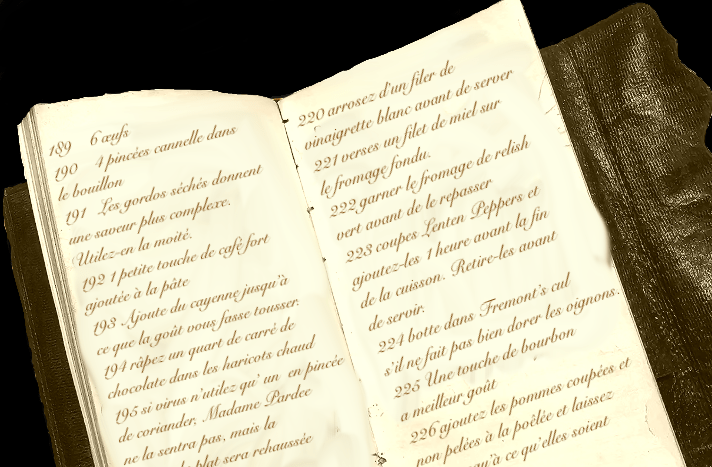
#193 Gumbo Noir
The following recipe is from the 1974 Blue Mocker Press cookbook, A TINGLE ON THE TONGUE: RECIPES FROM THE ROSE, edited by Mary-Alice Baywreath. It includes some of Amadeo Roselyn’s original notes. (Both Boudreau’s and Barbary’s were still open in 1974. The unfortunate Jorge was either very elderly by then, or long dead.)
1 Large Tender Chicken
1 pound of Boudreau’s Hot Andouille, chopped. Use only Boudreau’s. Tell him what you want it for, and he will go into the back and find it for you. If Boudreau’s cannot be obtained, another hot sausage will do, I suppose, but it must be fiery. Try Barbary’s General on Helenshed.
2/3 cup of lard, also preferably from Boudreau’s. [Ed. Note: vegetable oil, for modern eaters worried about their waistlines]
2/3 cup of flour
Ground black pepper
Ground Cayenne
Dried Thyme
3 crushed Bay Leaves
3 Tbs File powder
1 green bell, chopped
1 bunch scallions, sliced
1 scant handful of minced parsley
Enough chopped garlic to hold in your palm.
Cut up the chicken as if for fricassee
Heat the lard [or oil] in a large pot. Cook the chicken in it until the outside is brown, then remove to a plate.
Add the flour, stirring constantly. Make a roux the color of melted chocolate. add the chopped vegetables. Cook for 10 minutes, stirring.
Add a splash of water, the cut up chicken, salt, black pepper, cayenne, thyme, and bay leaves. Gradually add almost 2 more quarts of water, waiting until it is hot (but not boiling) before adding more.
Reduce the fire and allow it to simmer. Taste frequently, adding spices as needed.
After almost an hour, remove the chicken to a platter and allow it to cool slightly. The flesh and skin should come easily from the bones using just a fork. Add the meat to the pot.
After the chicken meat has been added, cook for a minute more, then turn off the heat. Remove the pot from the burner, and if it shows any sign of turbulence, allow it to rest. Only then may you add the file, which will turn the broth black, thicken it, and reduce the fire of the cayenne and sausage. Even those who fear highly spiced food can enjoy it, while those who prefer heat will relish the warmth in the aftertaste.
Serve in bowls, over a SMALL amount of boiled rice. Remind Jorge this is not a perlo and diners should enjoy the FULL benefit of the broth.
There are two major revelations at the end of Episode Six. The first is one that many viewers already suspected — the assimilated are subsisting on a liquid made, in part, from dead human bodies. The second is the logical outcome given that they cannot even kill plants. As the supplies of food dwindle, unreplenished by modern agriculture, the assimilated will all die of starvation in about ten years.
Carol goes to great effort to bring this news in person to the closest of the unassimilated to her, Mr. Diabaté. She plainly hopes it will shock him and the other survivors into resistance.
Mr. Diabaté responds with a calm, good-natured shrug. He tells her they already know.
The unassimilated, or at least Mr. Diabaté, did not make this dicosvery, as Carol did, by coming upon wrapped and chilled human body parts in a warehouse. They got the news carefully packaged, and couched in calm, “reasonable” terms, delivered by a smiling celebrity spokesman holding up a milk carton.
And so, they adjust. They swallow cannibalism and the prospect of human extinction as the new normal. And, conveniently for whatever is behind all this, they continue to focus on Carol as the villain. The unassimilated most likely tell themselves that this form of cannibalism is necessary to save those loved ones who have been assimilated, to forestall their eventual death by starvation.
That’s how moral attrition begins.
The hivemind’s imitation of human contact is not perfect and cannot last. “You are not my mother,” Manousos says to the woman who’s been bringing him food. “My mother is a b*tch.” The limitations put on the hivemind, the imperative to be nice, placating, is too far from the reality of what his mother was like, so Manousos figured it out quickly.
Partying with the assimilated will stop being fun for Mr. Diabaté. Laxmi will notice her son’s far too adult self-possession. The assimilated will realize, more and more, that their loved ones are not truly their loved ones.
But the more damage is done, the harder it is for those who rationalized, those who “understood”, to backtrack. Shifting from acceptance to resistance will involve admitting, not only that their loved ones are no longer their loved ones, but that they, themselves, accepted cannibalism — one of the most powerful human taboos.
And that’s how moral attrition continues.
The unassimilated who get along by going along are going to face an untenable choice — either burying themselves even deeper in denial or admitting they have embraced something unspeakable.
And perhaps hardest of all will be admitting that Carol, whom they have ostracized, whom they either despise with righteous indignation or pity as hopelessly deluded — was right.
I spent the day at work in front of the computer putting in the poll, in front of the typewriter writing letters, in front of the file cabinet looking for some photos that Catherine Crook De Camp wanted. I hardly saw Charlie at all, who stayed in the front room conferring with Shelly and Quina. In the afternoon he departed with Quina to run errands. They got back just as we were all leaving, Charlie and Quina hauling in crates of liquor and mineral water for the upcoming parties.
Yes, letters were written, not on the computer, but on a typewriter. Not sure why.
The filing cabinet of photos was called “The Morgue”, as I believe such archives were called at newspapers in general.
The Morgue could be fun to leaf through, especially since it included a thick file of letters from Harlan Ellison. He could be trusted to send LOCUS an enraged “Why-do-you-HATE-me?” letter following any review of his work, good or bad. The file was labeled “The Whimper of Whipped Harlan.”
Today, Bill Contento installed Pagemaker 3 and showed me how to use it. The colors are different, and the logo. For much of the day I stayed in the back office with Bill and Faren, getting the hang of Pagemaker’s new autoflow feature, so it occaionally got a bit crowded. Charlie, who was in a good mood now that another issue is under his belt, kept coming back to see how things were going, then darting away because he couldn’t stand watching it any more.
Late in the afternoon I drove Charlie down to Berkeley to leave some galleys and a book cover at The Other Change of Hobbit. Lisa Goldstein was there. Then we went to Andronico’s where we both did a little shopping. By the time we got back to Locus it was time to go home.
Charlie was blind in one eye, which screwed up his depth perception, so our duties included chauffering. Sometimes that meant visiting the local bookstores — The Other Change of Hobbit and Dark Carnival in Berkeley, Fantasy Etc. in San Francisco… The Other Change of Hobbit has, alas, gone the way of many bookstores and no longer has a corporeal form. At that time it was in a little shopping complex on Shattuck, always brightly lit, never cluttered or shadowy, but well-stocked with the latest and best in fantasy and science fiction. It was, as all important bookstores should be, a social center where part of the visit was pausing to gossip with the owners, Debbie Notkin and Tom Whitmore, or the writers who freqented it. Lisa Goldstein, the author of THE RED MAGICIAN, was at that time a small, blackhaired, pretty woman of about my own age, and everything I aspired to be in a writer. She still is. Wish I could remember what we talked about.
Andronico’s back then was the ne plus ultra of high end supermarkets — soft lighting, with soothing music, wide aisles, and an amazing selection of produce, etc. It has since been swallowed up by Safeway.
Today, Bill Contento installed Pagemaker 3 and showed me how to use it. The colors are different, and the logo. For much of the day I stayed in the back office with Bill and Faren, getting the hang of Pagemaker’s new autoflow feature, so it occaionally got a bit crowded. Charlie, who was in a good mood now that another issue is under his belt, kept coming back to see how things were going, then darting away because he couldn’t stand watching it any more.
Late in the afternoon I drove Charlie down to Berkeley to leave some galleys and a book cover at The Other Change of Hobbit. Lisa Goldstein was there. Then we went to Andronico’s where we both did a little shopping. By the time we got back to Locus it was time to go home.
Charlie was blind in one eye, which screwed up his depth perception, so our duties included chauffering. Sometimes that meant visiting the local bookstores — The Other Change of Hobbit and Dark Carnival in Berkeley, Fantasy Etc. in San Francisco… The Other Change of Hobbit has, alas, gone the way of many bookstores and no longer has a corporeal form. At that time it was in a little shopping complex on Shattuck, always brightly lit, never cluttered or shadowy, but well-stocked with the latest and best in fantasy and science fiction. It was, as all important bookstores should be, a social center where part of the visit was pausing to gossip with the owners, Debbie Notkin and Tom Whitmore, or the writers who freqented it. Lisa Goldstein, the author of THE RED MAGICIAN, was at that time a small, blackhaired, pretty woman of about my own age, and everything I aspired to be in a writer. She still is. Wish I could remember what we talked about.
Andronico’s back then was the ne plus ultra of high end supermarkets — soft lighting, with soothing music, wide aisles, and an amazing selection of produce, etc. It has since been swallowed up by Safeway.
I stopped in at Old Wives Tales on Valencia this afternoon . Got Mom a belated Mother’s Day gift of Alterhorn earrings, and a pair for myself. It’s a feminist gift shop that offers a fairly even selection of the lovely and the hideous. Female torsos decorate the walls along with spider web glass clocks and Kathe Kollwitz posters.
Old Wives Tales, which closed in 1996, was an important feminist bookstore, run as a non-profit collective by 1988. When we went to eat at We Be Sushi or pick up something at Lucca’s Ravioli, I always walked down the street to either go into Old Wives Tales or peer through its window. I remember it being staffed mainly by dauntingly intelligent and handsome lesbians.
Now it’s just a ghost — or rather, a smaller ghost of that host of phantoms that make up the larger ghost of Valencia Street in the ’80s.
Clear but cold. The issue, thank God and all His angels, will go out tonight.
Faren is on edge. Charlie wants her to learn Pagemaker, but the fact that she knows next to nothing about pasteup will make it difficult for her to extrapolate the process onto the screen. There were some tense conversations with Charlie in the back. Feel sometimes like I’m locked in a cage with them.
Was he thinking of firing me?That would have been dumb beyond belief, not because I was some super-competent employee, but because I was the one person in that office who knew Pagemaker . Faren was an editor and writer. Asking her to move from that to wrestling with a DTP program was insanity.
I had learned Pagemaker in spite of Charlie, who seemed to think computer programs could be acquired by a sort of osmosis. He’d downloaded it onto the computer, then expected me to know it just by turning on the computer and exporting Wordstar files. Fortunately, shortly after purchasing Pagemaker, he left town for a convention during a long weekend. While he was away, I literally broke into his house/office every morning, climbing in through his kitchen window and clambering over the sink. For three days, the bulk of my time was spent sitting in that back office, poring over documentation and practicing. By the time he returned I was, if not proficient, at least competent.
I still wonder if he ever put two-and-two together and figured out how I did that. Charlie could be stubborn and madly unreasonable, but he was not stupid.
Gray, gray, wet misty day. Awful morning. I got to work at 8:09 as I promised Charlie. He was in a terrible mood. Richard Curtis called and said his copy of Fritz’ manuscript arrived without a last page. God only knows how that happened. I was embarrassed and Charlie was livid. We express-mailed Richard the last chapter, which is only two pages.
The day got no brighter. I felt as though I were running in place. Finally, I managed to jam in both Heinlein’s and Simak’s obits and appreciations. By the end of the day, Charlie had mellowed enough for me to ask him if I could have Thursday and Friday off for the trip with my parents. “Sure,” he said, “as long as the issue is out.” I think it will be.
Because of the Heinlein additions, the issue was so big I had a hard time backing it up. Had to squash it. Also discovered that someone had obliterated the floppy back-up by overwriting another file onto it. At least I think that’s what happened.
First one in, last one to leave.
Not sure what “squashing it” meant here.Possibly doing a Save As, which seems obvious now and wasn’t back then. It might have been risky given the bugginess of Aldus Pagemaker, could have resulted in the entire file being overwritten and then erased.
Backing up was no simple matter. It involved, as I recall, a mysterious black device and some DOS commands.
It’s hard to name my favorite, but I think it must have been Frances Hodgson Burnett’s The Secret Garden, which I encountered after A Little Princess. The slightly oversweet taste of A Little Princess‘ heroine was dispelled when I read a character’s decription of the The Secret Garden’s protagonist — “A more marred-looking young one I never saw in my life.”
Mary Lennox is the anti-Sara Crewe. Sara’s hair is rich, brown and abundant. Mary ‘s hair is yellow and sparse. Sara is beautiful. Mary is ugly. Sara is almost preturnaturally sweet and loving throughout the book. Mary is, in the beginning at least, an ill-tempered, entitled little racist. In short, Mary is a far more believable orphaned scion of the white presence in English-occupied India than Sara Crewe could ever be.
Obviously, I was not aware of that when I first read it. I just knew, as much as I loved A Little Princess, Mary Lennox and Misselthwaite manor were more interesting to me. So, I frequently returned to the book. When I reread it in my teens, then my twenties, it revealed even more. Adult readers are likely to speculate that, once puberty hits, Mary Lennox’s close friendship with her sickly cousin Colin and the pan-like country boy Dickon is likely to become a bit complicated.
Which is why at least one filmed adaptation includes a coda set many years later, and a sequel, Back to the Secret Garden, takes place during WWII. In both, Dickon is absent and Mary is either engaged or married to Colin — which makes sense. As a working class country boy in the first decade of the 20th century, poor Dickon has WWI cannon fodder written all over him.
A lot of tension at work, most of it centered around Charlie and Frank Robinson. I overheard Charlie apologizing to him. Still don’t know for what, exactly, but likely connected to Heinlein’s obit.
The first section of the issue is finally done, though it was a long, irritating process. The computer crashed every few minutes, and it took me more than three hours just to get out pages 57, 58, and 59.
Somewhat to my amazement, I was able to start home a little after six. I gave Robinson a ride home. “Locus is a high pressure place, isn’t it?” he commented in the car.
The computer crashes were likely the result of using Aldus Pagemaker, an unbearably buggy early DTP program.



 Pam Troy