


Click the image to see more.
Click the image to see more.
I dislike this word for the same reason I dislike the clumsy use of the term “ban,” so let me start out by saying that no, I would not want to see people punished and/or silenced for uttering the word “problematic.”
But I do dislike it. Intensely. I dislike how earnestly it’s used, often with a faint moue of regret. I dislike, most of all, the built-in presumption that everyone listening agrees with its application.
Few things anger those who use “problematic” more than someone saying, “Wait, what do you mean? Why is that author/book/movie/artist etc. ‘problematic?’” It frustrates them because “problematic” is most frequently invoked on the way to advocating the exclusion/silencing/shunning of any person or work dubbed “problematic.” Questioning its use means they have to stop and think, not only about why something has been deemed “problematic,” but whether or not silencing (or “banning”) that problematic person or work is the right thing to do. The joy of their righteous march forward has been interrupted.
They might — God forbid! — have to formulate an argument.
This can be dangerous. Question whether or not someone or something is “problematic” and you just might be deemed “problematic” too.
It is the current favored jargon of the censor.
Which is a reality every writer faces.
My goal is to always have at least 70 queries out. To keep track of this, I have set up an Excel spreadsheet that I keep carefullly updated. Rejections are highlighted in yellow.
I started sending queries out in December, so I’ve reached the point where at least one rejection a day is arriving by email. Every day the yellow part of the spreadsheet grows. Every day at least one rejection must be replaced with a new query.
That’s just how it goes.
you were unkind.
You will never regret being kind, even when it didn’t work out.
When I was a teen-ager, my idea of hell was a housing development I’ll call Shangri-La. We didn’t live there, but friends did, and every now and then my family would get in the car and take the long drive out for a barbecue or dinner party or some other celebration.
The friends were nice. Their kids were nice. Their dogs were nice. The house was nice. But if it were a daytime event, and we lingered too long, and the food was consumed and the conversation petered out, the vaccuum that was Shangri-La would start to close in.
“Go out and do something,” one of the adults would say to us.
And so we would walk, block after stultifying block, past new, identical brick ranch houses with sliding glass doors and identical front yards planted with young, skimpy trees. There was no shade, no thick-boled live oaks or bunchy, low-branched magnolias, no spanish moss, no interesting wooden two storied houses with ghostly histories, no hills (this was Louisiana, after all), no bodies of water beyond square blue pools, no ruins to peek into and explore.
There was nothing, absolutely nothing for teenagers to do in that well-manicured, upscale, cropped green desert but sit on the monkey-bars and smoke pot at the deserted local school. And I hated pot. It made me feel stupid.
All of the teenagers we hung out with there seem to have grown into nice, law-abiding adults, but for years, I was convinced those suburban pools of sensory deprivation were hatcheries for incipient school shooters and serial killers.
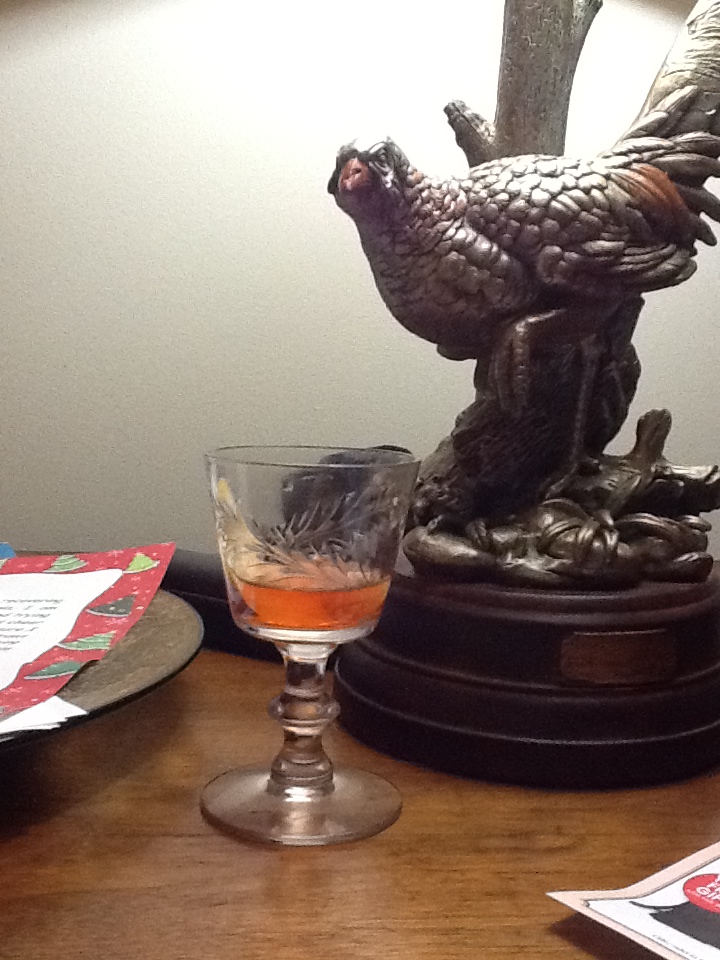
It was invented in New Orleans, I believe, by an apothecary named Peychaud. That’s why Peychaud’s Bitters are an important ingredient. Here is the recipe my brother gave me:
Chill an old fashioned glass in the freezer. Get it really really cold, thirty minutes ahead of time.
Put a sugarcube (or two) in a cocktail shaker and douse it with Peychaud’s Bitters. The cube should be saturated. I usually add a small splash of water.
With a cocktail muddler (or some blunt instrument), smash up that sugar, bitters and water until you’ve got a syrupy mixture in the bottom of the shaker.
Now add ice and two ounces of Rye Whiskey to the shaker.
Pull the chilled glass out of the freezer and add enough Absinthe to coat the inside of the glass. Rotate the glass sideways so the Absinthe swirls around and covers the inside surface area. Since the glass is so cold, the Absinthe should thicken and adhere to the sides. Dump out any excess Absinthe in the sink.
Strain the cocktail shaker into the glass. Twist a lemon peel around the rim and drop it in the drink.
I don’t care whether they agree with me or not, so long as they don’t take disagreement as a personal affront, and are interested in talking about it.
I bought them in 1996 because I was planning to travel to Europe with my new boyfriend, Michael. They were comfortable, durable, ugly and waterproof. I had seen a TV ad for shoes like them that showed a pair being walked through rain and puddles, the unseen owner pausing in inch-deep water before a larger pair of brogans to rise briefly on tip-toe — apparently to kiss the other owner. This appealed to me tremendously.
And so I wore them and walked in them with Michael across London, Paris, and Antwerp. They proved themselves in Antwerp, when, late on the night of October 31st, we walked arm in arm beneath an umbrella through a downpour, Michael grinning and weaving slightly from the Belgian beer he’d enjoyed as we edged around and through crowds of students out celebrating Halloween. When we got back to the hotel we had to peel off our wet clothes and run ourselves a hot bath, but my feet, at least, were still dry and warm.
For years, they lasted, at last failing on a wet day in San Francisco when I felt rain trickling in and soaking my socks. Unwilling to give them up, I carried them to a cobbler on Polk Street, who did his best. Unfortunately, after he was done they no longer fit as well. I finally gave up on them after an anti-war march left me with a very sore, bruised, big toe.
Still, I did not throw them out. They are stored in my closet, and I toy with the idea of finding another cobbler who might be able to fix them. There’s always hope.
This question prompted me to look around the room, try to decide. There’s the small, light pillow a friend gave me, which was made, he explained, for throwing at cats when they are misbehaving. That friend is long dead now, a casualty of the AIDS epidemic, but I still use the pillow occasionally on my current cat.
There’s also the fingernail-sized scrap of rosy nacre the ocean tossed at my feet on some beach decades ago, my grandmother’s engagement ring, still stored away and waiting for an assessment, my own engagement ring, the gold necklace my father gave me…
But after reading this prompt I got up from my desk and searched at length for a small glass perfume bottle, because I could not, at first, remember exactly where it was, and that made me a little anxious. After some effort, I found it.
A lover gave the bottle to me many, many years ago. It was a slightly uncharacteristic gift from him — more romantic than usual. He presented it to me in the small box that came with it, upholstered in pink with an Asian pattern, and I could swear he said at the same time, “this is not an engagement ring.” (That wasn’t necessary. The box was plainly too big for a ring.)
Whatever he actually said, I remember him seeming slightly anxious, as though it were important to him that I like it. And that, too, was uncharacteristic.
I suspect he got it in Japantown. The bottle is pale, frosted glass, oval, just big enough to fit in the palm of my hand. There is a picture on it of a couple, a strong, samuraish man leading a horse and smiling at a woman who looks down demurely.
“It’s very old,” he said. “It’s very valuable.”
We were together for twelve years. We split up over thirty years ago. He’s been gone now for twenty years, died young, and quite suddenly, of an undiagnosed medical condition that could easily have been dealt with if he’d known about it. I was happily married to someone else by then.
The day an old friend phoned to give me the news I lay down and cried a little, not because my grief was little, but because it felt mostly buried, like something moving around deep inside me, rearranging things.
After he gave me that bottle I hugged him and assured him, truthfully, that, yes, I did like the gift, very much. I still do. He gave it to me.
Cooking at home.
Lying awake at night, worrying.


 Pam Troy