
Category: Uncategorized
-
Amadeo opened his desk drawer and took out the small leather-bound notebook he called his supplementaire…
There were the numbered recipes in the big book in the restaurant’s pantry, for whenever his cooks wanted to refresh their memory, and there was, carried in Amadeo’s vest pocket, his supplementaire. The recipes in the first could be shared with especially insistent customers — who were always puzzled about why the results never quite measured up when they tried them out at home.
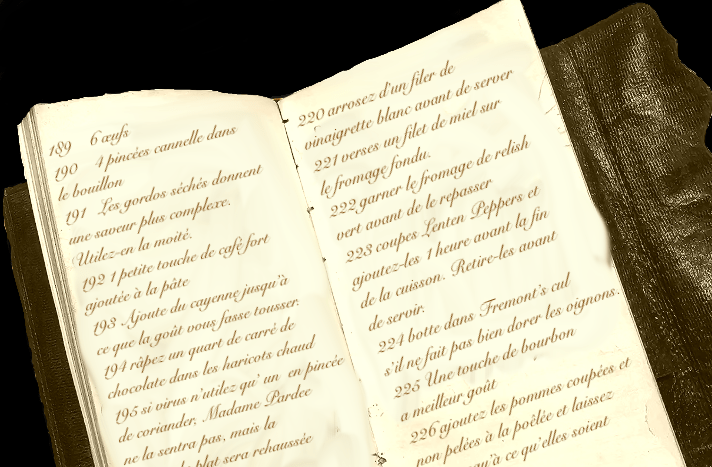
#193 Gumbo Noir
The following recipe is from the 1974 Blue Mocker Press cookbook, A TINGLE ON THE TONGUE: RECIPES FROM THE ROSE, edited by Mary-Alice Baywreath. It includes some of Amadeo Roselyn’s original notes. (Both Boudreau’s and Barbary’s were still open in 1974. The unfortunate Jorge was either very elderly by then, or long dead.)
1 Large Tender Chicken
1 pound of Boudreau’s Hot Andouille, chopped. Use only Boudreau’s. Tell him what you want it for, and he will go into the back and find it for you. If Boudreau’s cannot be obtained, another hot sausage will do, I suppose, but it must be fiery. Try Barbary’s General on Helenshed.
2/3 cup of lard, also preferably from Boudreau’s. [Ed. Note: vegetable oil, for modern eaters worried about their waistlines]
2/3 cup of flour
Ground black pepper
Ground Cayenne
Dried Thyme
3 crushed Bay Leaves
3 Tbs File powder
1 green bell, chopped
1 bunch scallions, sliced
1 scant handful of minced parsley
Enough chopped garlic to hold in your palm.
Cut up the chicken as if for fricassee
Heat the lard [or oil] in a large pot. Cook the chicken in it until the outside is brown, then remove to a plate.
Add the flour, stirring constantly. Make a roux the color of melted chocolate. add the chopped vegetables. Cook for 10 minutes, stirring.
Add a splash of water, the cut up chicken, salt, black pepper, cayenne, thyme, and bay leaves. Gradually add almost 2 more quarts of water, waiting until it is hot (but not boiling) before adding more.
Reduce the fire and allow it to simmer. Taste frequently, adding spices as needed.
After almost an hour, remove the chicken to a platter and allow it to cool slightly. The flesh and skin should come easily from the bones using just a fork. Add the meat to the pot.
After the chicken meat has been added, cook for a minute more, then turn off the heat. Remove the pot from the burner, and if it shows any sign of turbulence, allow it to rest. Only then may you add the file, which will turn the broth black, thicken it, and reduce the fire of the cayenne and sausage. Even those who fear highly spiced food can enjoy it, while those who prefer heat will relish the warmth in the aftertaste.
Serve in bowls, over a SMALL amount of boiled rice. Remind Jorge this is not a perlo and diners should enjoy the FULL benefit of the broth. -
Coyotes have practically become urban animals. I encountered one at dusk on Russian Hill last Christmas, loping towards me uphill on Mason Street. When it saw me it didn’t slow down, just veered gracefully around me and continued on its way. Foxes, too, live in the city, though they’re better at keeping out of sight, and the last time I saw one of those on Nob Hill was one night a decade ago — a silvery little thing with black muzzle and paws.
And, of course, there are raccoons. One night my husband felt something bump against his leg and looked down to see a mama racoon and her three kits file past. They barely even glanced at him. Do raccoons still count as wild animals? I’m not saying they’re pettable, but I have my doubts. They’re more like locals you know only to say hello. -

There are two major revelations at the end of Episode Six. The first is one that many viewers already suspected — the assimilated are subsisting on a liquid made, in part, from dead human bodies. The second is the logical outcome given that they cannot even kill plants. As the supplies of food dwindle, unreplenished by modern agriculture, the assimilated will all die of starvation in about ten years.
Carol goes to great effort to bring this news in person to the closest of the unassimilated to her, Mr. Diabaté. She plainly hopes it will shock him and the other survivors into resistance.
Mr. Diabaté responds with a calm, good-natured shrug. He tells her they already know.The unassimilated, or at least Mr. Diabaté, did not make this dicosvery, as Carol did, by coming upon wrapped and chilled human body parts in a warehouse. They got the news carefully packaged, and couched in calm, “reasonable” terms, delivered by a smiling celebrity spokesman holding up a milk carton.
And so, they adjust. They swallow cannibalism and the prospect of human extinction as the new normal. And, conveniently for whatever is behind all this, they continue to focus on Carol as the villain. The unassimilated most likely tell themselves that this form of cannibalism is necessary to save those loved ones who have been assimilated, to forestall their eventual death by starvation.
That’s how moral attrition begins.
The hivemind’s imitation of human contact is not perfect and cannot last. “You are not my mother,” Manousos says to the woman who’s been bringing him food. “My mother is a b*tch.” The limitations put on the hivemind, the imperative to be nice, placating, is too far from the reality of what his mother was like, so Manousos figured it out quickly.
Partying with the assimilated will stop being fun for Mr. Diabaté. Laxmi will notice her son’s far too adult self-possession. The assimilated will realize, more and more, that their loved ones are not truly their loved ones.
But the more damage is done, the harder it is for those who rationalized, those who “understood”, to backtrack. Shifting from acceptance to resistance will involve admitting, not only that their loved ones are no longer their loved ones, but that they, themselves, accepted cannibalism — one of the most powerful human taboos.
And that’s how moral attrition continues.
The unassimilated who get along by going along are going to face an untenable choice — either burying themselves even deeper in denial or admitting they have embraced something unspeakable.
And perhaps hardest of all will be admitting that Carol, whom they have ostracized, whom they either despise with righteous indignation or pity as hopelessly deluded — was right. -
A full moon last night, in the city decked out in its holiday best.
We went to hear the Count Basie Orchestra at Davies Hall, backed up by the SF Symphony. Except for Midnight Mass in a cathedral with a full choir, it’s the best way to experience Christmas music. Lots of brass, with an emphasis on the sax, and a singer in a multicolored sequined formal that, under the lights, was sending out flashes that could bounce off of satellites.
-
Write: Been doing that since grammar school.
Cook: I know more than the rudiments by now, and can make a good gumbo or jambalaya. Latkes, however, still elude me.
Manage a database or spreadsheet A fondness for logic (it was the only math class I not only passed in college, but excelled in), combined with profound laziness meant that in my working past, I would research and learn any shortcut or macro possible in Word, Excel, etc. Why take several hours to do something I can finish within minutes with the press of a button?
Debate: My dad taught us about formulating an argument and sticking to the point. He also taught us about logical and moral consistency.
Type: Well over 100 words a minute.




 Pam Troy