by Sigrid Nunez.
I did not throw it hard across the room because A: It’s a library book and B: I was in Peet’s.
But I wanted to.
More later.
by Sigrid Nunez.
I did not throw it hard across the room because A: It’s a library book and B: I was in Peet’s.
But I wanted to.
More later.
Not one, but two flashes and crashes of thunder over San Francisco.
Not rumbles. Crashes.
I have become a complete sissy about thunder.
We had a house-guest for the film festival, Jon, a tall, tall man, a chemist, with pale gray, amost white hair, and wire-rimmed glasses. He’s a member of a film club Michael helps moderate in San Jose, and he slept on our couch in between trekking off to the Kabuki or Castro to watch films.
Jon lives out in the countryside near Palo Alto in a communal complex where meals are taken in a large house close to the road. His own house there was purchased for a dollar, sawn in half, and moved to the commune by truck, carried slowly down the road in the dead of night. When they got it to its lot, they discovered the two halves no longer quite fit together, and they had to use a jack to make the house whole again. Jon showed us the seam in his wall once when we were there for dinner.
As soon as he arrived, he and Michael took off for the festival. We all agreed to meet at the Kabuki at 11:30 pm, and so late that night, after fortifying myself with a cup of cafe au lait, I dressed in my standard party costume (black jeans and black sweater) and walked to Japantown.
Youth lingered, though I did not consider myself young back then. These days I cannot imagine agreeing to begin a night out at 11:30 PM.
Jon still lives in his uneven house at his little communal community and still sleeps on our couch during the film festival. We are such fast friends now that we spent last Thanksgiving weekend together, the three of us renting an air b&b in Nevada City and spending three happy days walking, hiking, drinking wine and playing dominoes.
Shel’s party was on Saturday night. Shel has moved to New York and is now living in the East Village, but his landlord doesn’t know that. Mark is living in his place now, and Shel had returned to pack a few more boxes before driving back to New York. I’m sure Shel felt odd that night, as one always does when you return to an old home.
Shel’s a thin, dark, rather good-looking man in his late thirties, always a bit tense and watchful, fond of Frank Sinatra and martinis. The apartment is on Russian Hill. Technically, I suppose, it’s a single bedroom, though it consits mainly of a long hall with a kitchen at one end, a medium sized room at the other, and a bathroom and large closet in between. It’s a standard San Francisco apartment with hardwood floors, high ceilings, and anachronisms like a phone nook and an ironing closet. The room at the end of the hall has a futon where I suppose Shel once slept and Mark now sleeps. The little kitchen, with a tiny four-burner range cowering behind the refrigerator, has a shelf of cookbooks now, and spices and bottles of exotic liquors, where before it had mainly breakfast cereal and martini fixings.
It was a mix of Mark and Shel’s friends, which meant a lot of filmmakers and people from the magazine where Mark works. Bluff, talkative family men, skinny women writers, a Korean girl I’d talked to at Shel’s going-away party in January, Karla and Larry, a British couple, both of them working class vegetarians and leftists, Milford and Donna, a couple we had frequently encountered at Mark’s dinner parties. Mark, energetic and serious, danced with a tall, laughing woman in the parlor. Milford talked in the kitchen, Donna sitting nearby. Michael drank wine and grew very redfaced and hilarious. After my own glass of wine, I sat on Michael’s lap, no longer hearing most of what was being said and wondering, after looking around later, where Donna had disappeared to. Milford was still holding court beside the refrigerator, emphatic, almost belligerent.
Finally, after almost everyone else had gone home, we got up to leave, but on our way out Michael got snagged on Shel, who was standing near the door, and I was stranded out in the hall for fifteen minutes before giving up and coming back in. Found Donna sleeping peacefully on the parlor futon while Mark and his lady continued their dance a few feet away.
I have changed the names to protect the innocent. I’ll only say that “Mark” had a food column and “Shel” is a fairly well-known indie filmmaker, still living in New York, still slender and good-looking but gray, with a wife and a teenage daughter. The other partiers are still part of the San Francisco film community and occasionally their faces, altered by time, resurface in our lives in indie features and docs. “OMG! That guy being interviewed is LARRY! “
It’s the first week of the 43rd Annual San Francisco Film Festival, so I haven’t seen much of Michael. So far I’ve seen only two films. Wisconsin Death Trip, which I liked, and Peau d’homme couer de bete, which I did not care for.
We went to the opening night party on Thursday night. Michael had to film that evening, and he called from KQED just before heading out. I walked down the hill to the Regency Ballroom, which had the usual floodlights and Will Call table.
For the first forty-five minutes I wandered around the huge, dark ballroom, sampling the food at various tables — pungent soft white cheese spread on nutty bread, Calistoga berry juice, handrolls with peanut sauce, chocolate crepes, Aidelle’s sausage…. The music was very good, but loud. When I found Michael standing and talking to a couple, I could barely make out what anyone was saying. Barring a dance club, I’ve never understood the point of gathering large numbers of people in a room and then blasting them with music so it’s impossible for anyone to communicate without getting a sore throat. Eventually, we moved upstairs to a quieter second floor lobby nerar tall open windows that let in fresh air. We all talked about ghost stories, movies, what we loved and what we hated, and ate sorbet until they turned on the lights and send a security guard over to kick us out.
Outside on the sidewalk, the conversations continued. I talked to a thin, bearded older man who either knew me from a previous festival or was pretending to know me from a previous festival. He told me he spoke seven languages and had travelled all over Europe.
At the time, Michael was co-hosting a show on independent film at KQED. The result was, as his partner, I found myself in more conversations than usual at film events. Michael had some level of facial recognition from being on television, and I still suspect some hungry filmmakers were, quite understandably, trying to network with him through me.
I liked the book Wisconsin Death Trip was based on, so it’s no surprise I liked the movie. Of Peau d’homme couer de bete I have absolutely no memory. Who knows? If I saw it now, I might like it.
Where Aaben on California is small, dark, and claustrophobic, Acorn, around the corner on Polk, is airy and brightly lit. In Aaben, every customer is privy to every conversation at the front desk or anywhere else, while in Acorn, in spite of the brightness, there is complete privacy within the stacks. Conversations — even those close by — always seem faint and far away. The people behind the front desk are always busy at something, tapping into the computerized inventory, going through books, completing transactions… In Aaben, the only music possible would have to come from the radio behind the front counter. In Acorn, there is always interesting music being piped in over the sound system — classical, or folk, never top forty.
Last summer I applied for a part-time job there and was given what amounted to a written IQ test which included questions about my favorite authors and the last ten books I had read for pleasure. Apparently I did well, because the owner called me in for an interview. He is a tall, handsome, serious looking man with a gray beard, an ex-radical. He reminisced once about time spent in a jail after a demonstration.
Unfortunately, for the part-time job he had to ask for a commitment of twenty hours a week. I could not afford that at what he was offering in an hourly salary, so I politely declined.
Acorn, too, is gone. It’s now a gym. I miss it terribly, have missed it for years. To this day, when I’m walking down California towards Polk, something inside me tugs me in the direction of that lost, wonderful bookstore.
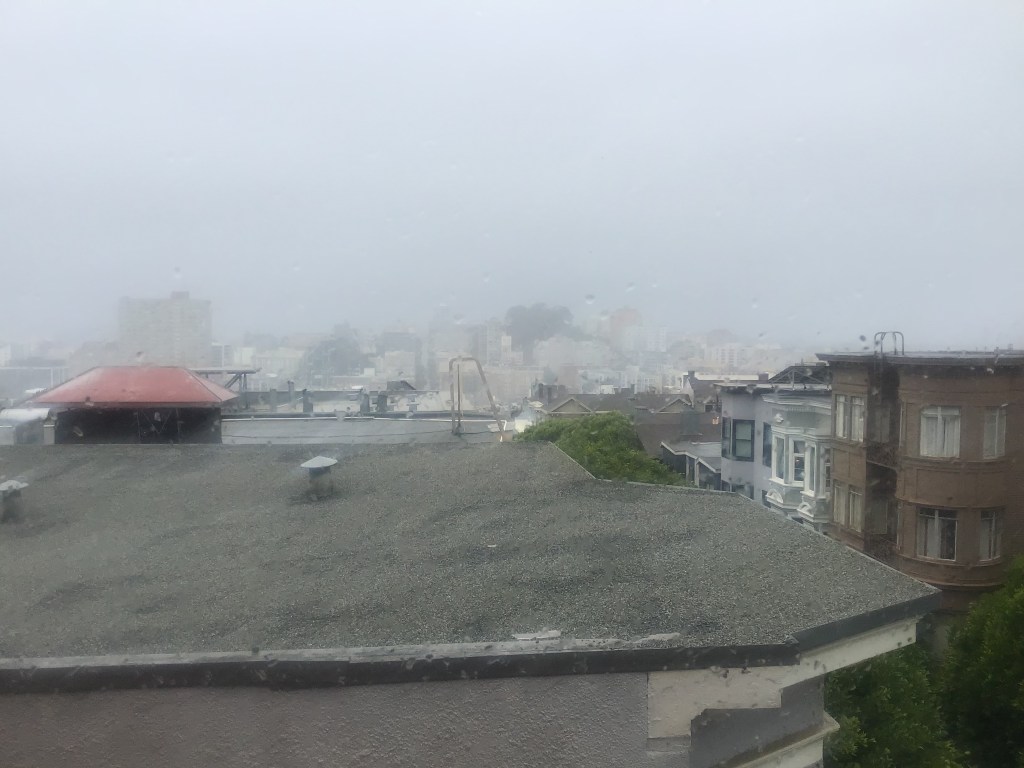
All gray, all wet, the pane spotted with rain, gusts of wind roaring and diving around hills and buildings like invisible, giant, avenging angels. The green treetops just over the roofs nearby thrash and pitch. Thunder rumbles and scrapes (never bangs) overhead. Not many cars are visible on the rising slope of our street blocks away, and the ones approaching have their headlights on, even though its just half past noon. That road, as always during storms, vanishes at its summit into gray nothingness. The Golden Gate Bridge and the Marin headlands have been erased.
Have our reservoirs been replenished?
Whether or not the drought is actually over, rain is no longer a novelty.
I visited the two neighborhood bookstores I go to about once a week, Aaben and Acorn.
Aaben is a small used bookshop on California, right next to the Cat Clinic, which is handy because Aaben has three resident cats, fat, friendly tabbies that somehow have been taught never to leave the store, even though the door is usually propped open. The (or a) owner of Aaben, a pear-shaped bearded man, died last summer, but the store soldiers on, an idiosyncratic little place that has sections marked out with handwritten labels, among them, “Zeitgeist,” “Americana”, and “Those Kennedys.” Usually the person behind the desk is a good-looking, moody boy in his twenties.
This time I found a paperback copy of John Hersey’s The Wall, the first adult book I ever read. I was completely convinced by it at the time (I was in junior high school) and remember visting the public library in a vain attempt to track down the works of Hersey’s fictional diarist, Noach Levinson.
Someone else had also been convinced. The book was shelved, not among novels, but in the nonfiction “Holocaust” section, in spite of the fact that a previous owner had written “FICTION” in pen on the cover, bearing down so hard the word is practically carved into it. Most of the ink, however, has vanished, so it would be easy for a bored, hurried shelver to miss. In addition, someone (probably the same person who wrote “FICTION” on the cover) had circled in red felt tip the “This is a work of fiction” note on the copyright page (1950. The book’s original price was 50 cents.) and drew an arrow pointing to it, and wrote again under the title page, in cursive:
fiction
not factual
There is more marginalia. On the inside cover, in that same felt tip, is written “Page 303” with 303 underlined, and below 303, in blue ink, “664”. Page 303 is the scene where Dolek Berson tries to save his sick wife, Symka. It was circled in red and proclaimed “a masterpiece!” Page 664 is the scene where an infant is suffocated. It, too, is circled, but in blue and without comment. I bought the book.
I was always a sucker for marginalia. That edition is still somewhere about.
Aaben, alas, is no more. It’s now a carpet shop.
THE WALL is a John Hersey novel plainly based on the diaries of Emmanuel Ringelblum, a Polish historian whose account of life in the Warsaw Ghetto was discovered after the war, buried in milk cans and metal boxes. Part of it is still unrecovered. Hersey’s book is a romanticized version of Ringelblum’s account, which I remember as a fairly impersonal, but important description of the nuts and bolts of life in the ghetto.
Unlike Hersey’s bachelor diarist, Ringelblum had a wife and children. He and his family were captured and executed by the Nazis in 1944. One account I have read is that, shortly before Ringelblum’s execution, the Polish resistance managed to break into the prison where he was held and offered to rescue him — but only him. It’s said he looked at his sleeping nine-year-old son, who was in the same cell with him, and refused.
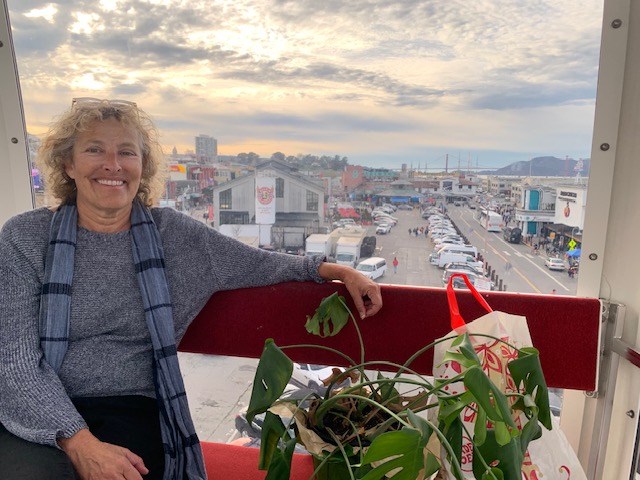
ANDREA AND HER PLANT
Yesterday was gloriously sunny, and at last I took a spin on the Ferris wheel at Fisherman’s Wharf. SkyStar, it’s called. It used to be in Golden Gate Park, but I think this location is far better, more in the thick of things.
A friend I met along the way came along. The Ferris wheel has become a landmark visible from quite a distance, so we simply walked down the hill towards it, my friend pausing to rescue a bedraggled Elephant Ear plant she found abandoned on a curb. Nobody, either in the line for tickets, or the line to board, commented on the drooping potted plant she held in her arms. “Everyone assumes old women are crazy anyway,” was her explanation.
The cars are small, enclosed, glassy lozenges rather than open, rocking benches in the sky, which I would have found more thrilling. I suppose it’s a question of both safety and comfort. The winds off the bay can be pretty cold. We took our seats, and began to rise slowly, pausing as each car was loaded. Once everyone had boarded the wheel turned, steadily, slowly, rising, offering views of Fisherman’s Wharf and the Bay, downtown San Francisco, and a beautiful mackeral sky rippled with clouds glowing in the afternoon sun. If I looked over my shoulder I could see Pier 39, dark with crowds, the sea-lions, who seemed shy that day, a little black clump on the corner of one of the docks.
The wheel rotates three times after loading, very slowly, with a minimum of rocking. For San Francisco residents our age, it’s quite reasonably priced, though they did take our picture and try to sell it to us for $46. We politely declined.
My friend walked home with her new pet. I plunged into North Beach in search of a cafe that sold wine by the glass. The one I found was cash-only, so I settled for a bar, the Comstock, where I sat at a little marble table, happily sipping a rose and alternately reading a novel and the latest New Yorker. I haven’t enjoyed reading so much since the days when I would curl up on my parents’ couch with a book and a plate of bacon sandwiches.
Paula’s replacement appeared on the Monday of my second week — Yolanda, youthful, solid, Salvadorean, plump as a partridge, brisk and ruthless as a buzz saw. Dierdre’s already numbered days at H&C were now even fewer. Yolanda and Lara immediately put their heads together and the balance in the com room became overwhelmingly young, Hispanic, and hostile towards white-haired old gringas. They chattered in Spanish as Yolanda pinned up pictures of her own little girl and they traded stories about her boyfriend and Lara’s husband.
The situation in the com room deteriorated, the hostility between Dierdre and the other two becoming more and more palpable. One day, Dierdre flatly refused to do something when Lara asked her, saying, “Ask Yolanda or Jinx, they’ll do it,” then marched upstairs. Yolanda told me about this, her voice low and excited. According to her, Lara retreated into shocked silence at her computer, trying not to cry. After a few minutes Lara went off to speak quietly to Portia. I was very glad I wasn’t there. That was Dierdre’s last day.
Yolanda had a mordant streak, describing with relish a movie she’d seen with a graphic description of someone getting run over by a bus. She also went into gruesome detail about her own difficulties with her daughter’s birth while poor Lara, a first time mother, clapped her hands over her ears and cried out “No! It’s cruel! It’s cruel!”
In spite of this, Yolanda seemed vaguely phobic about death. When I was showing her the storeroom where the party supplies and toners are kept, she reacted with horror to a hunting trophy, a moth-eaten wild duck crucified on the shadowy back wall. Every time she had to go in there, she would shudderingly avoid looking at it. Later, as she was cleaning off Paula’s desk, a book fell from the top shelf, and she reacted with exaggerated wonder and fear. (The notion of Paula as a poltergeist was too ridiculous for me to even contemplate.)
I resisted the urge to tell Yolanda that sometimes, when I was alone in the com room, I would hear a faint “Quack, quack, quaaaaack” coming from the store-room.
 Pam Troy