It was invented in New Orleans, I believe, by an apothecary named Peychaud. That’s why Peychaud’s Bitters are an important ingredient. Here is the recipe my brother gave me:
Chill an old fashioned glass in the freezer. Get it really really cold, thirty minutes ahead of time.
Put a sugarcube (or two) in a cocktail shaker and douse it with Peychaud’s Bitters. The cube should be saturated. I usually add a small splash of water.
With a cocktail muddler (or some blunt instrument), smash up that sugar, bitters and water until you’ve got a syrupy mixture in the bottom of the shaker.
Now add ice and two ounces of Rye Whiskey to the shaker.
Pull the chilled glass out of the freezer and add enough Absinthe to coat the inside of the glass. Rotate the glass sideways so the Absinthe swirls around and covers the inside surface area. Since the glass is so cold, the Absinthe should thicken and adhere to the sides. Dump out any excess Absinthe in the sink.
Strain the cocktail shaker into the glass. Twist a lemon peel around the rim and drop it in the drink.
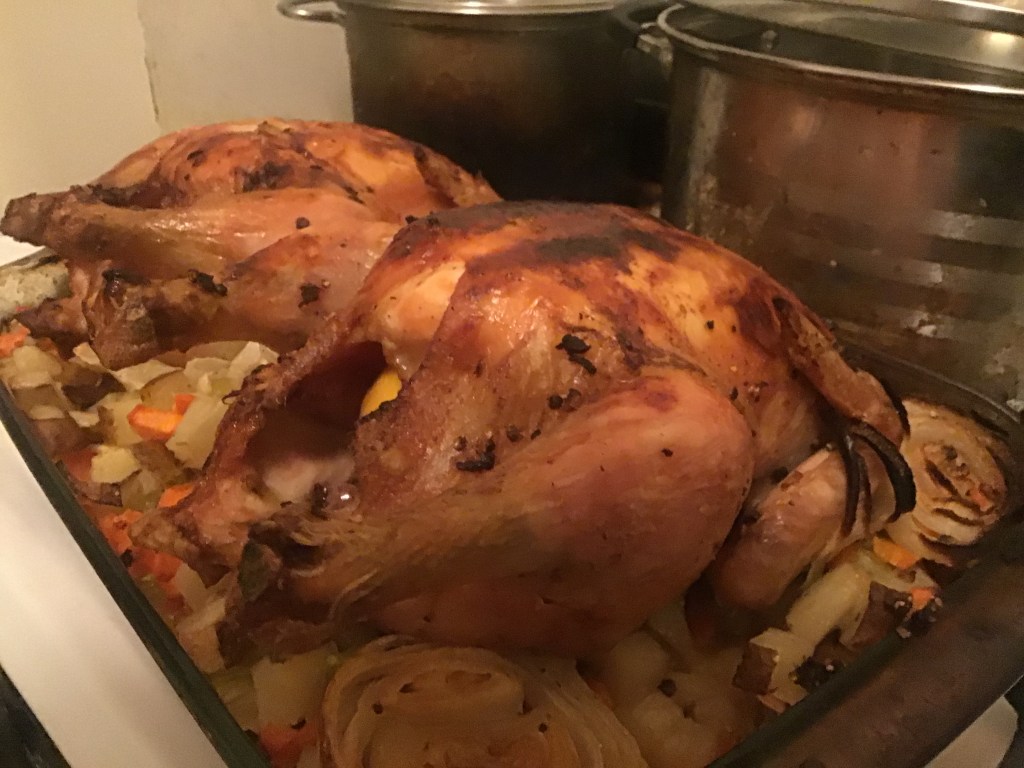
I found the first recipe in a cheap, trade paperback cookbook published out of Atlanta and riddled with typos, The 7 Day Menu Planner, by Cynthia Hizer Jubera. At that point in my life I was lonely and at loose ends and I was searching for the best recipes for certain dishes — roast chicken, apple pie, fish soup, chocolate cake, etc. This was where I found what is now my go-to roast chicken recipe. It tastes good, it’s relatively healthy, and it often leads to chicken and bread pudding.
2 whole chickens 2 tsp salt 1 tsp ground black pepper 4 minced cloves of garlic 1/2 c olive oil (pref. extra virgin) 2 lemons 2 onions, sliced thick 5 stalks of celery, sliced 5 carrots, sliced 3 Ibs of russett potatoes, cubed 2/3 c fresh lemon juice 1/3 c. chicken broth
Preheat the oven to 500.
In a small bowl, stir together salt, black pepper, garlic and oil. Rub this all over the chickens. Pierce each lemon numerous times with a fork, and put one inside each chicken. Spread the vegetables on the bottom of the roasting pan (I always put the sliced onions on top) and set the chickens on them, breast side up. Stir together lemon juice and broth and pour over the chicken and vegetables. Roast, uncovered, 20 minutes, then turn the chickens over and roast for 20 more. Make sure to baste the vegetables.
Lower the heat to 450 and turn the chickens breast side up again. Cook, continuing to baste, until the meat thermometer says both chickens are done. This usually takes about an hour. Carve the chickens and serve with the vegetables as a side. Be sure to squeeze some of the juice from the pierced lemons over the hot dish just before serving.
Once the vegetables are all eaten (that usually takes a day or two) it’s time to make chicken and bread pudding.
This recipe’s origin is Joyce Goldstein’s excellent cookbook, Solo Suppers. Her version is more of a soup, but I use enough bread to end up with a delicious bread pudding. I don’t make this as often as I used to because of the high bread, fat, and sodium content, but every now and then, I indulge myself.
You will need:
1 stick of butter 2 tbs olive oil 1 diced onion 2 diced celery sticks 2 small, diced carrots 2 cs leftover chicken meat 1/2 c dry white wine 4 cs chicken broth 2 pinches of ground cinnamon 1 loaf crusty Italian bread, cut into 8 slices 1/2 c grated parmesan
Melt half the stick of butter and the 2 tbs olive oil in a pot over medium heat. Add the diced vegetables once it starts to bubble and cook for about 10 minutes until softened. Add the wine and cook until it evaporates. Slowly add the broth, keeping it at a simmer, and some salt and pepper to taste, then the cinnamon. After all the broth is added, cover the pot and simmer for 30 minutes, adding the cooked chicken in the last 10 minutes.
While this simmers, melt the remaining half stick of butter in a skillet and use it to toast the bread slices until golden on both sides.
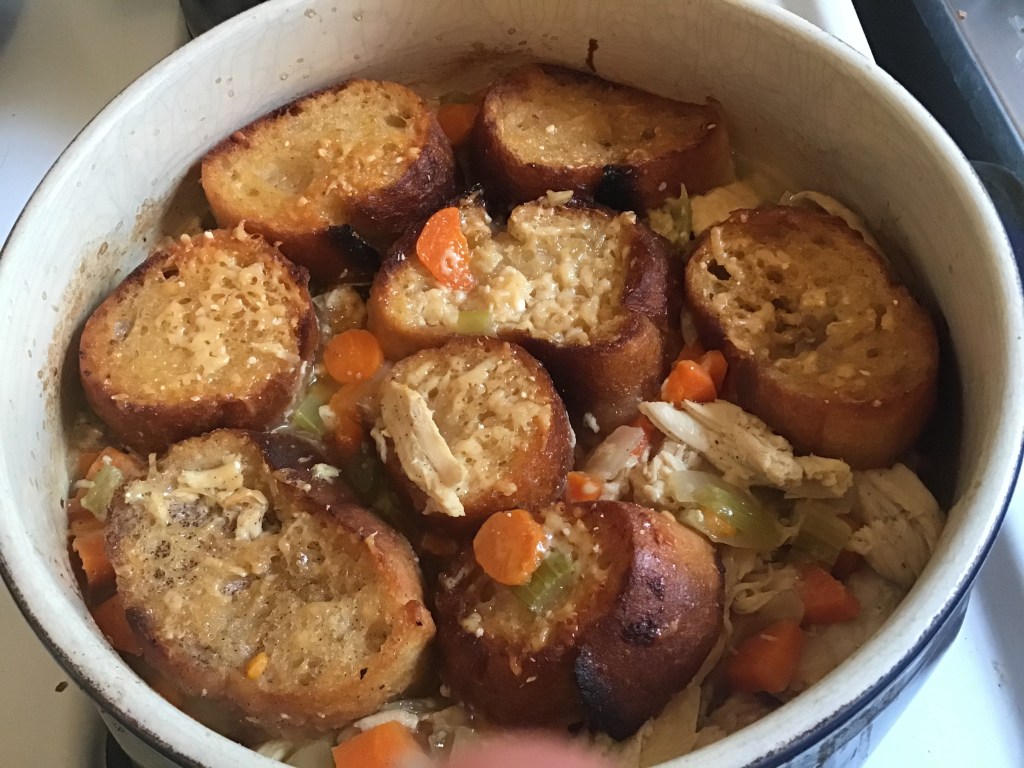
Preheat the oven to 300. Arrange four of these slices on the bottom of a deep dutch oven or casserole. Sprinkle with half of the parmesan, then use a slotted spoon to lay the chicken and vegetables on top of the bread. Top this with the other four slices, pour the broth over it, and sprinkle with the rest of the parmesan. Cover, either with the pot’s top, or a loose covering of foil. I generally bake it for an hour.
This should be the result:
Try to resist digging in immediately. It needs to cool for at least 15 minutes.
(Note: I used a french baguette instead of my usual Italian bread in this case. Still delicious.)
Bloganuary writing prompt
Write about a few of your favorite family traditions.
For better or for worse, American southerners drink a lot. The further south you go, the hotter the climate, and the more likely it is that dad unwinds at the end of the day by throwing ice into a glass and pouring something strong over it.
My grandfather’s drink of choice at family celebrations was milk punch — cold, cold milk, nutmeg, and liquor. It’s frequently made with brandy, but I’m pretty sure he preferred his with bourbon. He was one of those handsome, charismatic southern men who could convince everyone around him that what he liked, everyone should like, so at family events I remember the scent of bourbon and most of the adults sipping tall glasses of white stuff under the pecan tree beside the bayou. (I am not just pulling out cliches here. My grandparents really did live on the banks of a bayou, with a magnificent pecan tree in their back yard. My grandfather did not, however, have a neatly trimmed Van Dyke beard, and he never wore a white suit, slouched hat, and black string tie. He was a clean-shaven FDR/JFK liberal.)
A few years after he died, at another family event, someone confessed they didn’t like milk punch. It turned out that most of the adults in my family didn’t like milk punch, so that family tradition vanished. I was in junior high school then. I’ve since discovered that I, for one, like milk punch, but nobody else does, and the house on the bayou with the pecan tree was sold long ago so I can’t recapture the experience.
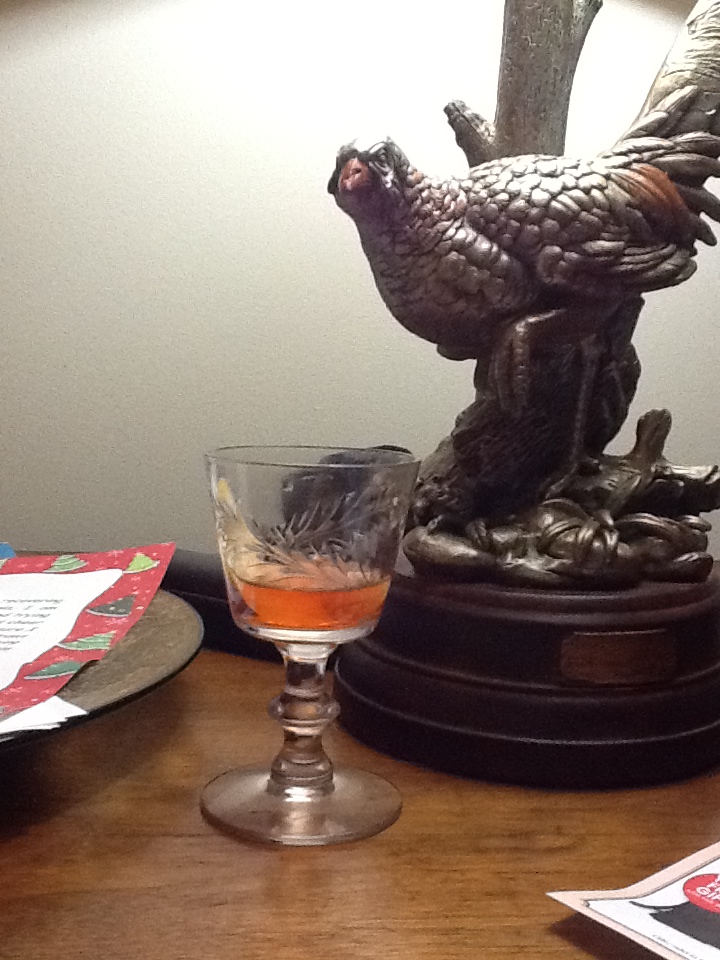
For my generation, it’s sazaracs. My father was a martini man, but on special occasions, he made sazaracs, possibly in tribute to the city where it was invented, his beloved New Orleans. My youngest brother has taken up the torch, and at some point when we get together, that’s what we have. Sazaracs include a sugar cube, Peychaud’s bitters, rye whiskey, and absinthe. (We once found ourselves unable to find absinthe. Jaegermeister, which has a similar anise flavor, is a tolerable substitute.)
It should be served and savored in a short chilled glass. The “sazaracs” guzzled on Bourbon Street in tall plastic cups are a mockery of everything the true sazarac represents.
For the ultimate family experience, now in California, they should be drunk during a long, contentious game of dominoes on the back patio by the pool near the orange tree.
Daily writing prompt
Describe an item you were incredibly attached to as a youth. What became of it?
My mother purchased it in New Orleans, sometime between 1955 and 1958, shortly after she and Dad set up housekeeping. She probably got it in some drugstore and paid a couple of dollars for it. They used to be everywhere. I remember seeing a row of them on a hardware store shelf as late as the early ’70s.
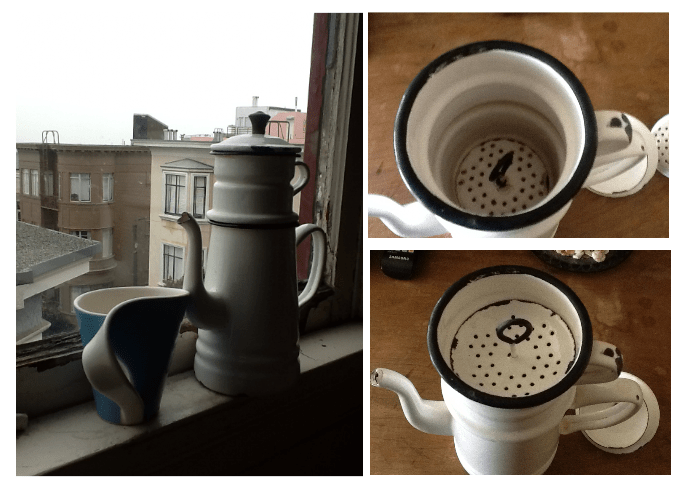
It was a constant presence in the kitchen, usually resting in a simmering pan of water on the stove. Early in my childhood — especially during my father’s student days at Tulane — it was kept constantly filled, like a Russian Samovar, brewing strong coffee smoothed out with a touch of chicory. Sometimes, when his frat brothers came over to study, Dad would grate chocolate into the little strainer on top.
By the time I was in middle school, it was used to make the cafe au lait my brothers and sister and I all had for breakfast in front of the fireplace on schooldays. High school, it was there, college when I came home, it was there. Through much of my young adulthood, it would be there, on the counter when we came to visit.
A few years ago, after my father died, Mom sent it to me, each of its parts carefully wrapped. She did not include instructions, and searching the internet was frustrating. I would find pictures of similar pots, most of them badly battered, missing parts, and priced well over a hundred dollars. Many of them were photographed with flowers blooming out of the top. I saw at least one being used as a planter. Nobody seemed to be using them to make coffee.
Finally I broke down and emailed Mom, admitting I needed help.
You heat a shallow pan of water on the stove. You grind the coffee and put it in the attachment, top that with the smaller strainer, then set the pot in the simmering water. You heat more water just to boiling, and very slowly pour it in, stopping once the top section is filled, then allowing it to strain. Every now and then you pour in a little more boiling water.
The idea, back in the fifties, was that either Maman or MeeMaw or the maid would do this while making breakfast, pausing while frying the eggs or bacon to pour in splashes of hot water. It takes about half an hour to get a brewed pot. It’s worth it.
I don’t make coffee with it every day, but I do for special occasions — especially Christmas morning. Maybe I shouldn’t. The enamel on the outside is cracked, and who knows about its integrity inside? But I can’t bear to set it aside and use it as a mere ornament. It seems alive to me.
For Christmas, at Michael’s request, I made sausage Jambalaya. It’s not a dish I cook much anymore, given concerns about fat and sodium content. Last night, just as I was stirring it before serving, I realized I’d left out the Thyme. That was an accident, but I also deliberately cut the amount of salt in half. (Why even add salt when you’re cooking with ham and sausage?)
Michael didn’t seem to mind, and it turns out I actually like it better this way. It’s creamier and got a nice sweetness offsetting the heat.
Also, I made a chocolate apricot cake. And a pot of Smoking Bishop. Lovely celebration.






 Pam Troy