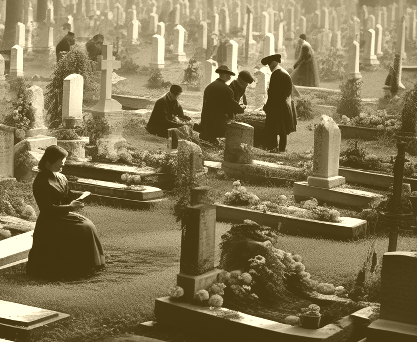
“On All Souls it’s better the un-bereaved say their prayers at Saint Elmo’s, where only God can hear them.”

“ There were the native fetishes called ‘dub-dubs‘ found buried or hidden in rocky niches, small wooden figures now heavy with the nails that had been driven into every inch of their surfaces. Like most gestures of despair, they still retained a little power, but the spirits banished from them were merely gray veils of sadness hovering over certain glades and beaches.”
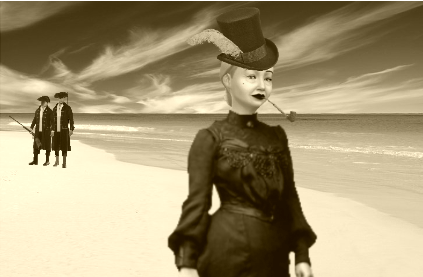
Thirty years before, according to Dr. Teach, Madame had propped the photograph of her dead husband, lit by two candles, up on his vault at Mariner’s Rest the day after his funeral. She then set her desk just inside the tomb’s open doors and conducted business there, flanked by two militia men, as prominent islanders lined up to learn whether or not they remained in favor with the Reckoners. Thus, La Reckoner had cast her husband’s shadow before her and reminded everyone of his will.
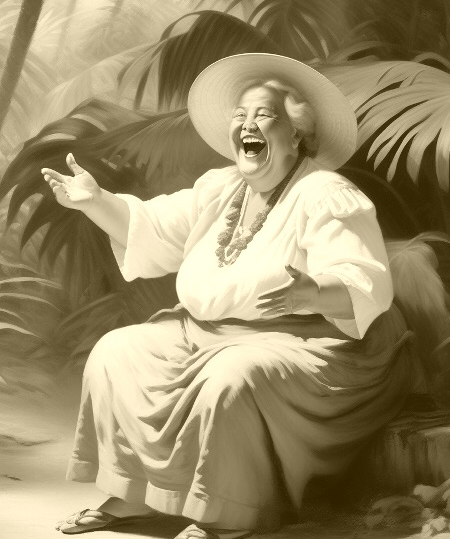
“A man is but a candle-stick
A woman is the holder…”
“The Light in the Cove” is a ribald ballad in English about an old woman lusting after the ghost of a young man. Everyone on the island knows both the melody and the words, though few respectable women or wise children will admit to it.
It was originally a wistful native song called “Elaro.”
But that’s forgotten.

… Longstaffe was a rebellious young aristocrat or a conscience-stricken slaver or a pirate whose brutality and ruthlessness made Henry Morgan himself shake his head in appalled disapproval.
He was hanged for defiling a well or he was slain and eaten by the Tomami or he was slain and eaten by his shipwrecked mates because they were hungry or perhaps just because he was unpopular and they were trying to make a point. Or he became a hopeless drunk and was found dead from Paresis on the sands of Sanctuary Strand.
The only consistent part of his legend is his virility and his paramour, Deep Gertie.

“‘What is this Theodosia?’ demanded Gwennoelle.
‘Why, Madame,’ The man bowed to her slightly. ‘It is a little town on the east side of the island. Very pretty place, with its own market, and lovely cottages, newly built and ready for newcomers like you. It’s where many of our workers live.‘”
The Island Council is especially proud of the “workers’” cottages that cluster around plantations throughout Theodosia, freshly painted in red and white and each with their own small vegetable plot. This housing is prominently pictured and described in advertisements for plantation workers in ports like New Orleans, Naples, and Dublin, their sturdiness and comfort extolled, along with the availability of schooling for children.
The heat, the uncovered cisterns, Yellow Fever, and the houses’ actual tenants are not mentioned.

“Oh, aye, I see this one around sometimes. One of them Dudays. Things go missing when he turns up.”
Telesphore “Tel” Fortune Duday is not the eldest living Duday child. That would be Laurette, his sister who was born one hour before him in Fourche in 1873. He is, however, their eldest living son, and the one Maman considers the most promising. Her Telesphore is clever and energetic. She likes the way his eyes meet hers when she explains something to him. One can almost hear the ticking of his brain as he thinks. He plainly draws his own conclusions, but he is a wise son, and never contradicts or questions his mother. Once he is fledged and comes into his talent, who knows how far he will go?
Tel’s piercing, fiery-blue gaze will become legendary on the island, and his adult reputation as a sorcerer will surpass his mother’s, though he will be considered much more approachable and engaging than “herself.” He has a broad, humorous smile, and the knack of making the person speaking to him feel like the only person in his world at that moment.
Those who love him will call him “charming.” Those who don’t will call him “insidious.”
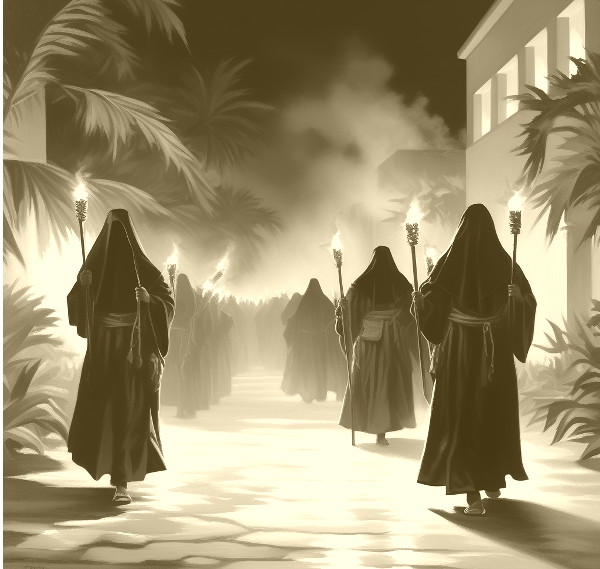
By now, they could clearly hear the nightwalkers, voices, drums and cymbals, singing a braided song. The first part had a steady, almost menacing beat, while the second part twined about it a long wail. It took Amadeo a moment to recognize the tune as one he’d sometimes heard in New Orleans.
Only when the line of torches turned onto the Gilmartin’s carriageway could he make out the words:
“Hi, ho,
Nobody home,
No eat,
Nor drink,
Nor money have we none.
Ye-et, we willllll, be me-e-eery,
Hi, ho…”

“No, I don’t believe the spirit of Gran’ Lamen guards his land.”
Ballou chuckled. “Do I look like a fool? I did not mean that.” He stared down at the tip of his cigar. “I meant the story of Gran’ Lamen and the hanging tree.”
Both men reflected for a moment.
Gran’ Lamen had been one African among many chained in the hold of the slaver Mary Donahue when it foundered off Pittime. He broke loose and freed his fellows before the ship sank. Not one white man made it to shore alive.
It was said that in the wars with the natives, Gran’ Lamen wielded a club that could kill twenty savages at one swing. It was said he was eight feet tall and he had twenty-five adoring wives of every color. This harem cooked his enemies and fed them to him by hand in bloody, rare morsels, while some of his fifty children sang and the rest fanned him with palm fronds.
It was said that when the Island Council voted seven to six in 1808 to give slave smugglers a port in return for a cut of the profits, all seven members who had voted in favor were found hanged the next morning from the live oak in the main square. Gran’ Lamen, who by then was not one day under sixty, stood beneath the dangling bodies, placidly smoking his pipe. Nobody asked questions.
Amadeo and his guest contemplated this. “I would like to think it was true,” Amadeo said. “Wouldn’t you?”
 Pam Troy