Amadeo opened his desk drawer and took out the small leather-bound notebook he called his supplementaire…
There were the numbered recipes in the big book in the restaurant’s pantry, for whenever his cooks wanted to refresh their memory, and there was, carried in Amadeo’s vest pocket, his supplementaire. The recipes in the first could be shared with especially insistent customers — who were always puzzled about why the results never quite measured up when they tried them out at home.
#193 Gumbo Noir
The following recipe is from the 1974 Blue Mocker Press cookbook, A TINGLE ON THE TONGUE: RECIPES FROM THE ROSE, edited by Mary-Alice Baywreath. It includes some of Amadeo Roselyn’s original notes. (Both Boudreau’s and Barbary’s were still open in 1974. The unfortunate Jorge was either very elderly by then, or long dead.)
1 Large Tender Chicken
1 pound of Boudreau’s Hot Andouille, chopped. Use only Boudreau’s. Tell him what you want it for, and he will go into the back and find it for you. If Boudreau’s cannot be obtained, another hot sausage will do, I suppose, but it must be fiery. Try Barbary’s General on Helenshed.
2/3 cup of lard, also preferably from Boudreau’s. [Ed. Note: vegetable oil, for modern eaters worried about their waistlines]
2/3 cup of flour
Ground black pepper
Ground Cayenne
Dried Thyme
3 crushed Bay Leaves
3 Tbs File powder
1 green bell, chopped
1 bunch scallions, sliced
1 scant handful of minced parsley
Enough chopped garlic to hold in your palm.
Cut up the chicken as if for fricassee
Heat the lard [or oil] in a large pot. Cook the chicken in it until the outside is brown, then remove to a plate.
Add the flour, stirring constantly. Make a roux the color of melted chocolate. add the chopped vegetables. Cook for 10 minutes, stirring.
Add a splash of water, the cut up chicken, salt, black pepper, cayenne, thyme, and bay leaves. Gradually add almost 2 more quarts of water, waiting until it is hot (but not boiling) before adding more.
Reduce the fire and allow it to simmer. Taste frequently, adding spices as needed.
After almost an hour, remove the chicken to a platter and allow it to cool slightly. The flesh and skin should come easily from the bones using just a fork. Add the meat to the pot.
After the chicken meat has been added, cook for a minute more, then turn off the heat. Remove the pot from the burner, and if it shows any sign of turbulence, allow it to rest. Only then may you add the file, which will turn the broth black, thicken it, and reduce the fire of the cayenne and sausage. Even those who fear highly spiced food can enjoy it, while those who prefer heat will relish the warmth in the aftertaste.
Serve in bowls, over a SMALL amount of boiled rice. Remind Jorge this is not a perlo and diners should enjoy the FULL benefit of the broth.
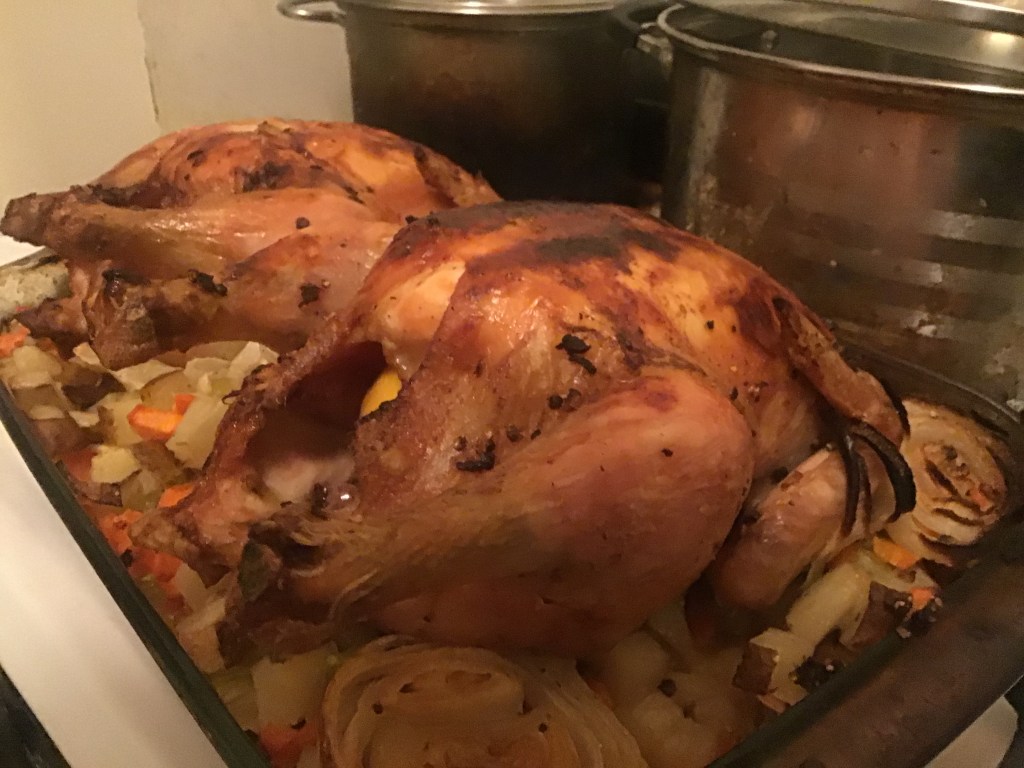
I found the first recipe in a cheap, trade paperback cookbook published out of Atlanta and riddled with typos, The 7 Day Menu Planner, by Cynthia Hizer Jubera. At that point in my life I was lonely and at loose ends and I was searching for the best recipes for certain dishes — roast chicken, apple pie, fish soup, chocolate cake, etc. This was where I found what is now my go-to roast chicken recipe. It tastes good, it’s relatively healthy, and it often leads to chicken and bread pudding.
2 whole chickens 2 tsp salt 1 tsp ground black pepper 4 minced cloves of garlic 1/2 c olive oil (pref. extra virgin) 2 lemons 2 onions, sliced thick 5 stalks of celery, sliced 5 carrots, sliced 3 Ibs of russett potatoes, cubed 2/3 c fresh lemon juice 1/3 c. chicken broth
Preheat the oven to 500.
In a small bowl, stir together salt, black pepper, garlic and oil. Rub this all over the chickens. Pierce each lemon numerous times with a fork, and put one inside each chicken. Spread the vegetables on the bottom of the roasting pan (I always put the sliced onions on top) and set the chickens on them, breast side up. Stir together lemon juice and broth and pour over the chicken and vegetables. Roast, uncovered, 20 minutes, then turn the chickens over and roast for 20 more. Make sure to baste the vegetables.
Lower the heat to 450 and turn the chickens breast side up again. Cook, continuing to baste, until the meat thermometer says both chickens are done. This usually takes about an hour. Carve the chickens and serve with the vegetables as a side. Be sure to squeeze some of the juice from the pierced lemons over the hot dish just before serving.
Once the vegetables are all eaten (that usually takes a day or two) it’s time to make chicken and bread pudding.
This recipe’s origin is Joyce Goldstein’s excellent cookbook, Solo Suppers. Her version is more of a soup, but I use enough bread to end up with a delicious bread pudding. I don’t make this as often as I used to because of the high bread, fat, and sodium content, but every now and then, I indulge myself.
You will need:
1 stick of butter 2 tbs olive oil 1 diced onion 2 diced celery sticks 2 small, diced carrots 2 cs leftover chicken meat 1/2 c dry white wine 4 cs chicken broth 2 pinches of ground cinnamon 1 loaf crusty Italian bread, cut into 8 slices 1/2 c grated parmesan
Melt half the stick of butter and the 2 tbs olive oil in a pot over medium heat. Add the diced vegetables once it starts to bubble and cook for about 10 minutes until softened. Add the wine and cook until it evaporates. Slowly add the broth, keeping it at a simmer, and some salt and pepper to taste, then the cinnamon. After all the broth is added, cover the pot and simmer for 30 minutes, adding the cooked chicken in the last 10 minutes.
While this simmers, melt the remaining half stick of butter in a skillet and use it to toast the bread slices until golden on both sides.
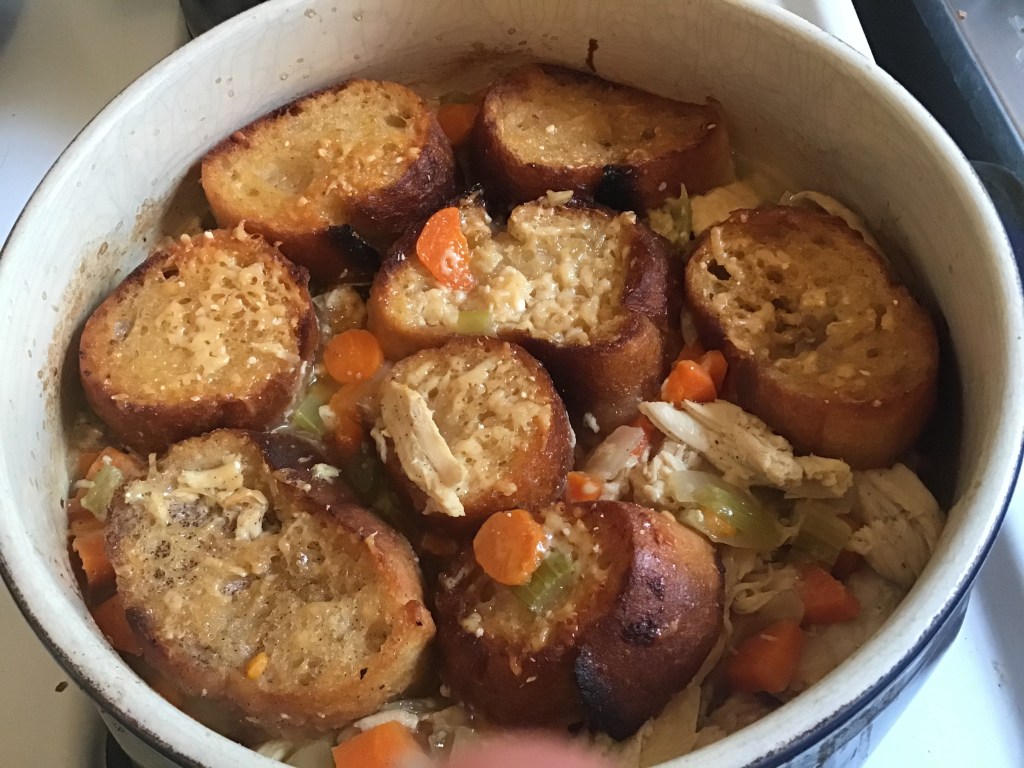
Preheat the oven to 300. Arrange four of these slices on the bottom of a deep dutch oven or casserole. Sprinkle with half of the parmesan, then use a slotted spoon to lay the chicken and vegetables on top of the bread. Top this with the other four slices, pour the broth over it, and sprinkle with the rest of the parmesan. Cover, either with the pot’s top, or a loose covering of foil. I generally bake it for an hour.
This should be the result:
Try to resist digging in immediately. It needs to cool for at least 15 minutes.
(Note: I used a french baguette instead of my usual Italian bread in this case. Still delicious.)


 Pam Troy