I suppose currently, the chore we avoid in this household is decluttering. It’s not like we’re hoarders wending our way through mountains of discarded pots and old newspapers, but we’re both writers, which means we’re both loathe to throw or give away books, movies, letters, magazines, paperwork, etc.
Going through these things involves a daunting level of personal archaeology. Dizziness can set in when you find a cancelled check written in 1996 to the hairdresser who did that dye job that blistered your scalp and realize it was in the last century. A Sacred Spaces calendar from 1986 can result in a twenty-something ghost appearing in a puff of patchouli-scented smoke, wearing her favorite tree-of-life indian-print skirt and snapping, “Don’t throw that away! I need it.”
Explaining to her that decades have passed, and that note she added in November about her flight from SFO to see the parents at Thankgiving is now irrelevant, gets you nowhere. She just can’t comprehend it.
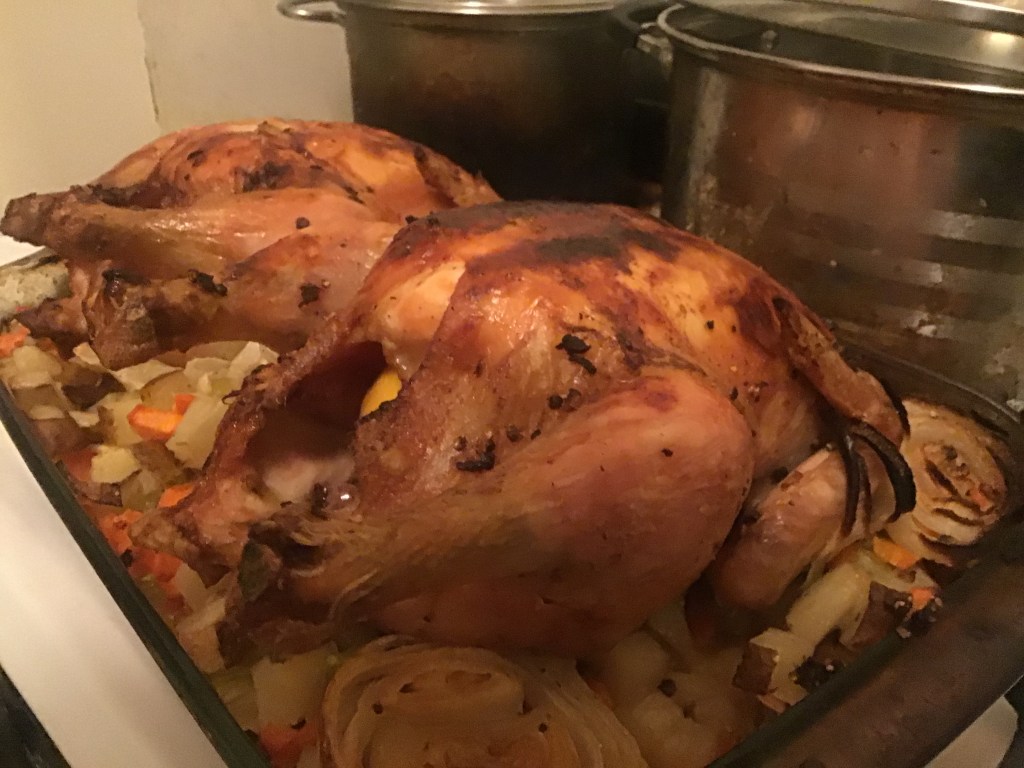
I found the first recipe in a cheap, trade paperback cookbook published out of Atlanta and riddled with typos, The 7 Day Menu Planner, by Cynthia Hizer Jubera. At that point in my life I was lonely and at loose ends and I was searching for the best recipes for certain dishes — roast chicken, apple pie, fish soup, chocolate cake, etc. This was where I found what is now my go-to roast chicken recipe. It tastes good, it’s relatively healthy, and it often leads to chicken and bread pudding.
2 whole chickens 2 tsp salt 1 tsp ground black pepper 4 minced cloves of garlic 1/2 c olive oil (pref. extra virgin) 2 lemons 2 onions, sliced thick 5 stalks of celery, sliced 5 carrots, sliced 3 Ibs of russett potatoes, cubed 2/3 c fresh lemon juice 1/3 c. chicken broth
Preheat the oven to 500.
In a small bowl, stir together salt, black pepper, garlic and oil. Rub this all over the chickens. Pierce each lemon numerous times with a fork, and put one inside each chicken. Spread the vegetables on the bottom of the roasting pan (I always put the sliced onions on top) and set the chickens on them, breast side up. Stir together lemon juice and broth and pour over the chicken and vegetables. Roast, uncovered, 20 minutes, then turn the chickens over and roast for 20 more. Make sure to baste the vegetables.
Lower the heat to 450 and turn the chickens breast side up again. Cook, continuing to baste, until the meat thermometer says both chickens are done. This usually takes about an hour. Carve the chickens and serve with the vegetables as a side. Be sure to squeeze some of the juice from the pierced lemons over the hot dish just before serving.
Once the vegetables are all eaten (that usually takes a day or two) it’s time to make chicken and bread pudding.
This recipe’s origin is Joyce Goldstein’s excellent cookbook, Solo Suppers. Her version is more of a soup, but I use enough bread to end up with a delicious bread pudding. I don’t make this as often as I used to because of the high bread, fat, and sodium content, but every now and then, I indulge myself.
You will need:
1 stick of butter 2 tbs olive oil 1 diced onion 2 diced celery sticks 2 small, diced carrots 2 cs leftover chicken meat 1/2 c dry white wine 4 cs chicken broth 2 pinches of ground cinnamon 1 loaf crusty Italian bread, cut into 8 slices 1/2 c grated parmesan
Melt half the stick of butter and the 2 tbs olive oil in a pot over medium heat. Add the diced vegetables once it starts to bubble and cook for about 10 minutes until softened. Add the wine and cook until it evaporates. Slowly add the broth, keeping it at a simmer, and some salt and pepper to taste, then the cinnamon. After all the broth is added, cover the pot and simmer for 30 minutes, adding the cooked chicken in the last 10 minutes.
While this simmers, melt the remaining half stick of butter in a skillet and use it to toast the bread slices until golden on both sides.
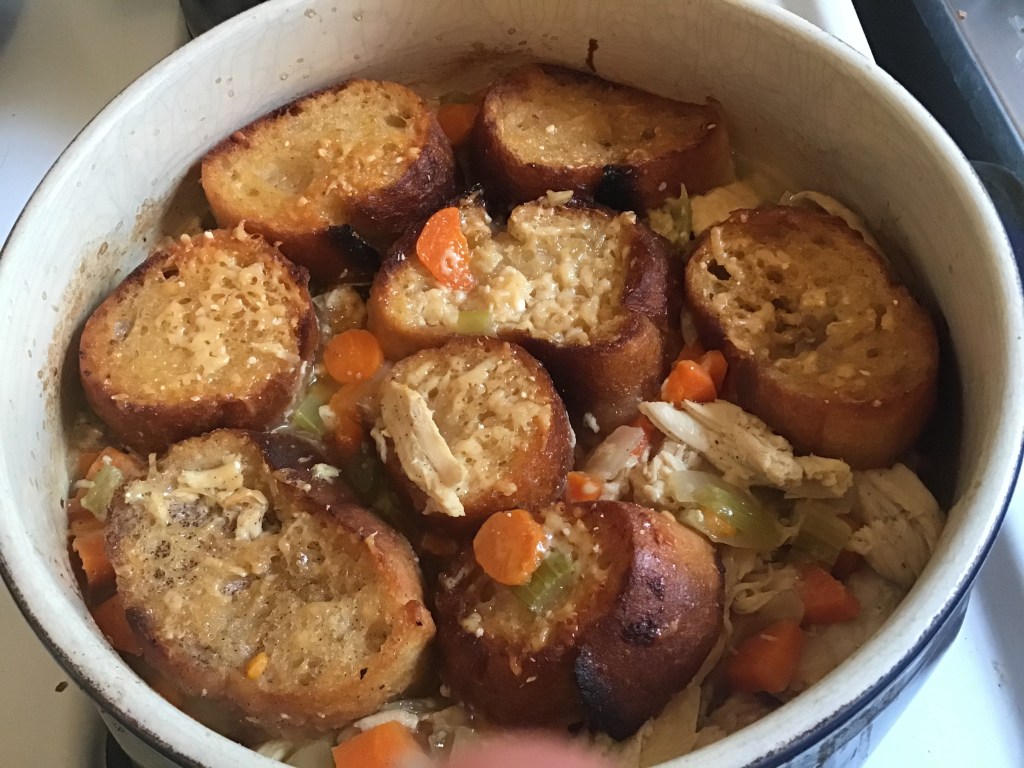
Preheat the oven to 300. Arrange four of these slices on the bottom of a deep dutch oven or casserole. Sprinkle with half of the parmesan, then use a slotted spoon to lay the chicken and vegetables on top of the bread. Top this with the other four slices, pour the broth over it, and sprinkle with the rest of the parmesan. Cover, either with the pot’s top, or a loose covering of foil. I generally bake it for an hour.
This should be the result:
Try to resist digging in immediately. It needs to cool for at least 15 minutes.
(Note: I used a french baguette instead of my usual Italian bread in this case. Still delicious.)
Big, with a tiny, dark screen that showed yellowish-green letters when you typed. It took old black floppy disks, large square things that were literally “floppy”, as in bendable, and it sat on the desk in the living room of the first apartment I shared with my boyfriend in Chapel Hill. I remember it through a veil of umber colors, a reflection of that apartment’s wooden floor and the old-money aura fashionable in the Reagan era. You can see it in the lighting of some movies in the eighties, like Once Upon a Time in America and The Verdict.
To get to USENET or some other site, we plugged it into the phone outlet and typed in a few lengthy commands, probably in DOS. There would be a horrible, almost indescribable scraping noise before we connected. Being online was a tenuous state of being. Interference on the line would result in random characters (#^&#!) appearing in the middle of whatever you were typing, so your perfectly reasonable Usenet post about the inroads Jerry Falwell’s Moral Majority was making on US political discourse would appear to be peppered with profanity. This, perhaps, is what laid the groundwork for the future tenor of online discussion.
On days when there was a lot of “noise” in the ether, it did no good to complain to the phone company because we weren’t supposed to be using the phone outlets to go online. Or at least, that’s what my software engineer boyfriend told me. It was never clear to me what the phone company would do about it. I just know that in those days, “The Phone Company” was still enough of a monolith that we didn’t want to mess with it.
Also, it was important to remember not to answer the phone if it rang while we were online because that would knock us off entirely.
Our poor Superbrain didn’t last long before it was replaced with a 1984 Mac. I don’t know what happened to it. Probably discarded when we moved to a new apartment . Maybe it got dismantled for parts, but I’d like to imagine it as still intact and in a museum somewhere.
Bloganuary writing prompt
What’s the thing you’re most scared to do? What would it take to get you to do it?
I cannot imagine skydiving. I’d only put on a parachute and jump out of a plane if the aircraft were on fire or if someone much larger than me were advancing on me with a knife.
Back in the 1990s one of my relatives, in late middle age, began ticking off his bucket list. He was telling some of his cronies at a diner how he wanted to try jumping out of a plane with a parachute, “just once, just to see what it’s like.”
“I can tell you that,” an older guy, a veteran of WW II said. ”It was dark. I was cold. I was scared. People were shooting at me. I didn’t like it.”
…and the fact that many people who embrace cruelty will bob their heads vigorously in agreement and say “Yes! Cruelty is the worst!“
The most frustrating vocation in the world must be that of the human rights advocate. Everyone claims to support human rights, but those who actually take the issue seriously are engaged in an eternal dialogue in which they struggle vainly to get people to understand what human rights actually mean.
“Rape, torture, and murder are bad,” says the human rights advocate. “We must not do these things.”
The rest of the world agrees righteously, eyes flashing with indignation. “Damn straight,” we chorus. “No torture, rape or murder!” Then our eyes brighten slightly. “Torturers and rapists and murderers are evil! They should be tortured and raped and killed…”
“No!” insists the human rights advocate. “No torture or rape or murder at all!”
“Yes, yes, you’re right! We must arrest and convict them first. Prison is the place for torturing and raping, and…
“No! Not even in prisons!
“Of course not, of course not. There are rules against that kind of thing in prison. We’ll just be careful to look the other way and not notice when convicted criminals are being tortured and ra…”
“NO! NO TORTURE AND RAPE AND MURDER MEANS NO TORTURE AND RAPE AND MURDER!‘”
And here the rest of the world stares with the horror and disbelief of a junkie who’s just been told what “cold turkey” actually means. “What you mean NEVER?”
It’s for this reason that I’ve grown leery of the words “good” and “evil.” Certainly I believe in the concept of evil and the concept of good. The problem is, many people apparently see these terms as applying, not to specific acts, but to mystic forces that indwell within certain individuals, like the Holy Spirit or Beelzebub. If an individual or society is inhabited by the spirit of “goodness,” what that individual or society does is by definition “good,” even if it involves funding death squads, or bombing hospitals, or ignoring the screams of a teenage shoplifter being gang-banged in a nearby cell.
As for those inhabited by the spirit of “evil,” any act committed against them is excusable or, at worst, “regrettable but understandable.”
“It’s OK,” the “good” say as they bulldoze another pile of mangled bodies into a mass grave. “We’re fighting the forces of evil.”
But not on television. I can’t think of any sport at all I would specifically tune in to watch on television — unless the Saints or the 49ers are playing in the Superbowl, and even then, the ads are half the fun.
I will, however, in a park or stadium, watch almost any baseball game from beginning to end. The one exception was a game I attended last autumn in Boston where it was raining heavily and the seats were close to the field but at such an angle I had to crane my neck to make out what was happening.
My preferred seating is high up in the bleachers so I can see everything play out below me. Which is why I don’t like watching baseball on TV. I don’t care what the batter looks like, and I don’t want to hear his stats. I don’t want to see a closeup of some young pitcher’s face as his sports career dribbles down the drain when he screws up. I’m not interested in hearing predictions about what the coach is going to do next.
I just want to eat a hot link and sit in the bleachers and watch that big, beautiful dial of a field tick through the innings, while I groan at outs and jump up and yell when someone gets to a base or home.
We would have two houses. One in the San Francisco Bay area, the other in the North Carolina Mountains. Maybe Asheville. Both houses would have excellent views, elevators, and a tremendous amount of shelf space for my books. Michael would have his own movie theater with an enormous screen.
We’d make sure our families were taken care of.
We’d buy the Castro movie palace, halt its current gutting into a music venue, and have it restored, including, if possible, the organ that dates back to the silent era and is now God-knows-where. We’d make sure the Castro functioned as a sort of rep house, screening either classics or indies.
I’d donate a large sum to the Mechanics’ Institute for maintenance of the building, and hopefully add a dedicated events space on the ground floor, with a stage, drop-down screen, and decent acoustics.
Other donations would go to various carefully researched causes, including Jewish organizations, film restoration, healthcare, literacy, animal rescue, domestic abuse, and women’s shelters.
We’d travel.
We’d have cats and dogs waiting for us when we came home.
One is Erasure, by Perceval Everett, the novel the movie American Fiction is based on. Everett is a graceful and witty writer, and so far the book is entertaining in the tradition of literary parodies like Stella Gibbons’ Cold Comfort Farm and Charles Simmons’ The Belles Lettres Papers. More like the latter, actually, because Everett skewers, not just fashionably bad prose, but the pretensions of the current literary establishment.
The other book I’m reading — slowly — is Alberto Angela’s tre giorni di Pompeii. I could find no English editions, or even one in French, which I could manage on my own, so I am chipping my way through it by dint of Kindle’s Bing translator. Which is why I am reading it at bedtime, when I want something that will make my eyelids heavy after ten minutes.
Erasure I am enjoying in the form of an actual book, one that doesn’t require occasional recharging. Now that I’ve retired, I’ve rediscovered my old pleasure of reading books in cafes. San Francisco has lots of those, and every afternoon I’m trying one out. Thursday it was Saint Frank’s (decaf) on Polk Street. Very bright, very clean, good coffee. I was the oldest person there, and the only one reading something that had a cover and actual pages. Everything in Saint Frank’s seemed white and smooth, the floor, the walls, the air… The smooth white counter is near the front, part of the decor, so you can watch the smooth, white young barista make your coffee with the smooth white equipment. All the other customers there were, if not white, then smooth, young and pretty and staring at screens. I felt like I was in a Kubrick movie.
Royal Grounds (short cafe au lait), on Friday, seemed older in every sense. Dark, small and a bit cluttered, the counter shoved into the back instead of proudly displayed as part of the decor in the front. At least one other customer, in her twenties, had a book open, even though it looked like college textbook and she was consulting it in between typing into a device. Another customer was a gray, slightly frayed Asian gentleman who looked to be in his fifties, scowling at the screen of his laptop.
This afternoon, I’ll try to track down a cafe that serves wine by the glass. North Beach is my best bet.
Bloganuary writing prompt
Write about a few of your favorite family traditions.
For better or for worse, American southerners drink a lot. The further south you go, the hotter the climate, and the more likely it is that dad unwinds at the end of the day by throwing ice into a glass and pouring something strong over it.
My grandfather’s drink of choice at family celebrations was milk punch — cold, cold milk, nutmeg, and liquor. It’s frequently made with brandy, but I’m pretty sure he preferred his with bourbon. He was one of those handsome, charismatic southern men who could convince everyone around him that what he liked, everyone should like, so at family events I remember the scent of bourbon and most of the adults sipping tall glasses of white stuff under the pecan tree beside the bayou. (I am not just pulling out cliches here. My grandparents really did live on the banks of a bayou, with a magnificent pecan tree in their back yard. My grandfather did not, however, have a neatly trimmed Van Dyke beard, and he never wore a white suit, slouched hat, and black string tie. He was a clean-shaven FDR/JFK liberal.)
A few years after he died, at another family event, someone confessed they didn’t like milk punch. It turned out that most of the adults in my family didn’t like milk punch, so that family tradition vanished. I was in junior high school then. I’ve since discovered that I, for one, like milk punch, but nobody else does, and the house on the bayou with the pecan tree was sold long ago so I can’t recapture the experience.
For my generation, it’s sazaracs. My father was a martini man, but on special occasions, he made sazaracs, possibly in tribute to the city where it was invented, his beloved New Orleans. My youngest brother has taken up the torch, and at some point when we get together, that’s what we have. Sazaracs include a sugar cube, Peychaud’s bitters, rye whiskey, and absinthe. (We once found ourselves unable to find absinthe. Jaegermeister, which has a similar anise flavor, is a tolerable substitute.)
It should be served and savored in a short chilled glass. The “sazaracs” guzzled on Bourbon Street in tall plastic cups are a mockery of everything the true sazarac represents.
For the ultimate family experience, now in California, they should be drunk during a long, contentious game of dominoes on the back patio by the pool near the orange tree.
Bloganuary writing prompt
Name an attraction or town close to home that you still haven’t got around to visiting.




 Pam Troy