Lie down
To slide into shadow
And learn
Water lapping
Sounds midnight blue
And smells of stones.
Sometimes I love female vocalists and songwriters like Rickie Lee Jones, Sam Phillips, or Kate Bush, sometimes heavy metal, like Sisters of Mercy, sometimes The Pogues or The Rumjacks or The Chieftains, sometimes Brian Eno, sometimes Curt Mansell. sometimes Enya. Depends on what story is running through my head.
At the moment I’m feeling angry and patriotic and perverse, so below is my day’s favorite song, “What Was Your Name in the States”, sung by The Rumjacks — an Australian band. It makes me think of my city’s early days, that somewhat mythical time when California — and especially San Francisco — was where you escaped “the States” in the east and remade yourself.
…in 2023.
Venice: One of the oldest, most beautiful, most fascinating tourist traps in the world. A city impossible to modernize, navigate or map, where you can safely get lost and where police work consists of giving directions to wandering tourists in the dead of night. Rococco, slightly vulgar and brightly painted in places, laced with canals and bridges, gift shops bristling with expensive masks and tschoskes, piles of muticolored cannoli in the windows of cafes. Excellent food, but it’s not a good idea to ask for a table too close to a canal.
Florence: Unlike Venice, a working city where people live that still functions as a working city where people live. Car horns honking among the ancient buildings, traffic lights, Vespas… Somewhere in the many red-to tan warrens of old buildings is the pensione where I stayed as a student, part of an old Medici palace, but damned if I could figure out which one. “I don’t want to constantly be visiting cathedrals” Michael had warned me before we left San Francisco, but he couldn’t seem to pass a single one without wanting to go in to look around. We stayed in an ancient building which had for a while been a 20th century monastary, now a hotel. Ours was a spacious, windowless suite with arched frescoed ceilings and a modern kitchenette so some past monkish resident (I pictured him as an earnest young man in a brown cassock and horn-rimmed glasses) could use the microwave to heat his solitary dinner in between meditation and prayer.
Pompeii: A sunlit walk through what amounted to a graveyard. The most haunting sight for me was not the plaster casts, but the beautiful black concrete floor of a villa’s courtyard, flecked with silvery chips of mica and as smooth and polished as it had been before the eruption. This was, we were told, so that someone carrying a lantern at night could easily navigate by the lampight catching the mica. I imagined how familiar, even comforting that pattern on the floor would have been to a resident over two thousand years ago. Then I imagined the skinny, battered feral cats who infest Pompeii running and stalking across it in the empty city at night.
Capri: Another joyful tourist trap. Stunningly well-dressed and wealthy tourists, scarily narrow roads, many fat, indulged and calm stray cats, especially the one that decided to sit and groom itself in the middle of the road while our macho, burly, Mastrioni-like guide pleaded with it from the driver’s seat. “Oh, kittykittykittykitty…” (After a minute or two of this, the cat, a long-haired gray tabby, glanced at us and magnanously strolled out of our way, tail in the air.) Getting up before dawn to see the Blue Grotto, eating an incredible arugula salad for lunch, drinking wine on the balcony of our hotel at dusk. A few mosquitos, but the wine and view were so good we really didn’t care.
Rome: More honking cars and vespas among ancient piles, occasional Roman era rows of cordoned-off ionic or corinthian columns, nighttime streets filled not just with tourists but with students, and so many gelato shops, pizza shops, olive oil shops… The biggest , best change I noticed from my student days were the many young women I saw walking by themselves at night on the streets of Rome and yet unmolested and unharassed by obnoxious men. Charming residents eager to show off their city, who confidently answered “yes” if we asked if they spoke English, then offered incomprehensible directions in a version of it we could not understand. Art museums where, quite possibly, my artist great-great-grandfather, a successful 19th century artist, sat and sketched copies of Renaissance paintings. The closer one got to the Vatican, the more serious young priests one saw with briefcases, usually walking alongside older men in black cassocks. The young nun in the Vatican shop who, except for her habit, looked like every other young woman working in a tourist shop, obviously bored and tilted forward, her elbows on the counter as she scrolled through her phone.
The flight to Chicago was crowded, but not intolerable. We sat up front in the middle section. The only hitch in the flight was an annoucement that, because of video difficulties, there would be no film on the flight which, since the movie would have been Disney’s The Kid, sent a palpable wave of relief through the cabin.
The plane arrived at O’Hare on time at around midnight, and we had to work out how we were going to reach Highland Park. Washed up at a bleak bank of payphones along with other exhausted looking travelers trying to score a ride. Eventually Michael got through to a taxi company.
It was a long, long drive across a dark, flat, alien landscape, with only occasional neighborhoods of fat brick houses visible from the highway, very northern looking behind the spidery black branches of bare trees. I felt unreasonably troubled by the lack of lit windows. (It was, after all, around 2:00 AM by then.)
We got lost in Highland Park. It’s amazing how completely black and sinister a civilized suburb of ranch houses can be when they’re too badly lit to illuminate street signs. At one point, the driver pulled over to consult a map. We found the street after that, and we paid him in the driveway, picked up our bags, and walked to the unlocked front door.
Shall I count the ways this journey would have gone differently today? Half-assed, not especially popular movies shown to the whole plane cabin on a single screen and a single audio system. Banks of pay phones at the airport that you had to stand in line to use. A taxi, rather than an uber. A paper map…
The issue came in at about 4:00 pm and we immediately got to work on First Class, (except for Quina who was making plum jam in the kitchen.) Part of First Class got done and carried off to the Western Addition post office. The rest will be finished tomorrow.
As usual, Russ was the first to arrive, followed by Shelly’s Paul, Dave Nee, Lisa Goldstein and her husband, and others. (Tim stayed home because we already have other parties this week.) Everyone sat around on sofas and the floor, stuffing envelopes, mostly for overseas and Canadian. The night was so warm it was like a southern summer evening, and we ate hamburgers outside on the deck.
I left at about 10:00 pm, giving Russ a ride home.
When I walked into the apartment, it was to the opening credits of Raiders of the Lost Ark. Tim finally found a copy of it. It was the first movie we saw together as a couple.
SPOILER
I loved RAIDERS OF THE LOST ARK when it came out, not so much because of Harrison Ford, but because of Paul Freeman, who played the villainous-but-sexy Rene Belloq — whom I was bitterly disapointed to see killed off at the end.
Why, Stephen? WHY?
I made it my business, from middle school on, to learn about both the Civil War era and the Third Reich.
I read everything I could about these eras because it apalled me that both the Southern Confederacy and the Third Reich were based on brutality and dehumanization. How did Germans and southerners justify it to themselves? How did it get to the point where people — who could otherwise be personally kind and decent — believed destroying other human beings, either through slavery or simple extermination, was not just okay, but moral and just?
This led me to read as much as I could about propaganda and how it normalizes atrocity.
Which led me to be alert when I saw how dehumanization worked around me, whether among my neighbors justifying the My Lai massacre (“They were all COMMIES, so…”) celebrating the deaths at Kent State, (“They were all HIPPIES so…”) or dismissing the murders of civil rights workers (“They were all TROUBLEMAKERS from the north so…”)
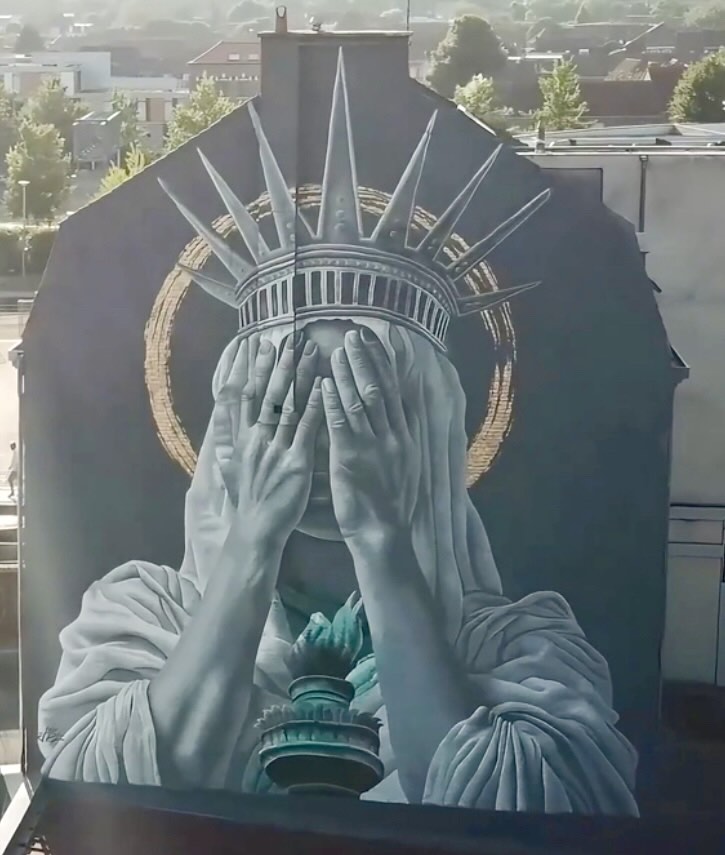
Now I hear “They are ILLEGALS, so…”
I don’t remember the title or the name of the filmmaker.
The production values were quite high, with many gorgeously green overhead shots of open fields edged with mist, obviously taken from a helicopter. The film itself was completely incomprehensible to me and rather repellant, though I did maintain a mild interest in the main character, a goat man apparently in the thrall of three beefy eunuchs with pink hair. We first encountered him tap-dancing in a dock house, while two racers tore across the English countryside with something vaguely gray and greasy oozing out of their overalls.
After tap-dancing a hole through the dock-house floor, the goat man fell into the ocean and continuted tap dancing on its sandy bottom, kicking up filmy clouds of silt.
The racers paused to have one of the eunuchs put a pink, phallic-looking wheel on the car and then, after some reflection, remove it.
Audiences at the Art Institute have a high tolerance for the avant-garde, but after about 45 minutes I could sense people getting restless. There were quie a few walk-outs, and I began hearing feet shuffling and throats clearing as the movie went on and on.
I looked over at Michael. He was slumped back in his seat, his eyes closed, his breath deep and regular.
Onscreen, the goat man had found some sort of secret passageway under the ocean and was crawling through it, becoming more and more enmeshed in white foam. The audience shuffled and cleared their throats. I dreaded what might happen if Michael began to snore.
He did not open his eyes until the final scene, a close-up which I will not describe except to say it caused a lot of men in the audience to groan and reflexively gesture towards their crotch. Michael, his eyes bulging, stared at the screen trying to make sense of where he was, what he was seeing, and what the Hell was going on.
The credits began to roll, some in the audience clapped rather defiantly. The rest sprang to their feet with barely concealed relief.
I had seen films at the Art Institute that were stranger and less interesting, but those were usually very low-budget by filmmakers who were obviously struggling. The hostile reception might have been a reaction to the director having so much money to burn.
We now have a new Locus car, a bright red mini-van. Shelly fell in love with it yesterday during her test drive. She joined forces with Quina to convince Charlie it would be a perfect van to take to Yosemite. After Charlie and Quina used it to run errands, he returned to Locus a little downcast. I overheard him telling Shelly, “I just don’t feel the same sense of ownership anymore.”
..a boy whose schtick was that he wasn’t one bit romantic. He “warned” me about that early on. “You should understand,” he said, settting his jaw grimly over our Sweep-the-Kitchen pizza at Friday Frank’s, “that I’m not romantic. Girls need to know that before they get involved with me. I’ve learned…” He trailed off, his eyes fixed on distant vistas and remembered pain. “It’s just best you know now.”
I gravely assured him that was okay. I wasn’t ‘romantic’ either.
Then I went home with him, looked at his bookshelf, and saw he had every Michael Moorcock novel ever written, including the Elric novels. Considered explaining the term “Byronic” to him, then decided against it. He was a computer science major and didn’t really need to know.
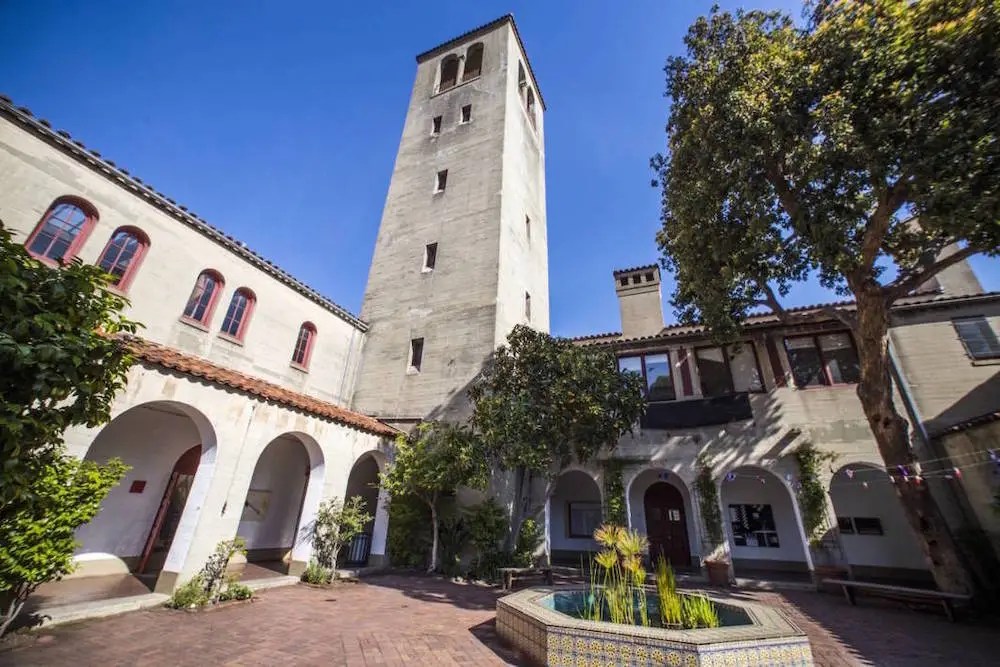
On Satuday night we walked down the hill to an Art Institute event, a series of Ken Anger films. The Art Institute is a rather medieval/Spanish looking building, all broad corridors and courtyards. To our dismay, we found when we got there that we’d arrived an hour late. It was long after dark and we stood in one of its cold galleries looking out onto a courtyard, Michael negotiating with the stocky, dark-haired man running the event. We could hear the soundtrack to one of the films.
After the applause we made our way into the theater, which was dark and so packed we had to sit on the aisle steps, already dotted with people. The Anger film, Lucifer Rising, was a collection of colorful, vaguely Satanic images that managed to be interesting, even without an identifiable story-line. A lovely woman in Egyptian garb reclined on the foot of a massive sphinx. A handsome, long-haired man covered in blood bathed in a huge bathtub. The music by Bobby Beausoliel (currently serving life for a Mansonesque murder) was quite good.
After the film was over, a few people left and Michael and I were able to get a couple of seats. Unfortunately, that had been the last Anger film. (I would have liked to see Rabbit’s Moon again.) The next film had a title I don’t remember.
…but it was memorable, and deserves its own entry.
The building that housed the San Francisco Art Institute stills stands, but it’‘s currently an empty gray pile at the foot of Russian Hill, A non-profit has bought it and will presumably resurrect the place as The California Academy of Studio Arts. I am hopeful, but won’t hold my breath.


 Pam Troy