Daily writing prompt
You get some great, amazingly fantastic news. What’s the first thing you do?


Open the boutique bottle of whiskey we’ve been saving. Make Manhattans.
Open the boutique bottle of whiskey we’ve been saving. Make Manhattans.
Went to the Waldenbooks on Geary.
At Powell Street there were two evangelists, the usual black man in the white suit, red feathered hat, and AIDS pasteboard, and an old white guy with a megaphone, which I thought was kind of unfair. On the corner of Powell and Geary was yet another evangelist, waving a black, floppy-covered bible, pacing and declaiming alongside a meek little old lady who was wordlessly passing out tracts.
Then I passed a demonstrator, apparently against the Iran Iraq war. A lady on the street behind me crowed, “I’ve never seen a real, live demonstration before!” She was plainly from out of town.
In front of Neiman Marcus I walked past a group of people demonstrating against the wearing of furs.
This is a very opinionated city.
At Waldenbooks I bought a new diary (this one is about finished) and a paperback true-crime anthology.
The black evangelist with the red feathered hat and pasteboard was for years a fixture at the Powell Street Cable Car turnaround, where he could moodily grumble into his microphone at a captive audience of tourists queuing for a ride. I remember him as very dapper, with sunglasses and a well-trimmed beard in addition to his hat and three-piece suit. He would bring a small carpet to mark out his territory, and a chair where he sat next to his sign, along with a posted warning that he would charge a fee to anyone who photographed him — thus following the venerable San Francisco tradition of making a spectacle of oneself, then objecting because people notice. (The Castro did the same thing for years, its residents costuming wildly on Halloween Night, then complaining afterwards in letters to the Chronicle because “outsiders” were taking pictures.)
I was a regular in the area, so the black evangelist’s occasional growls were frequently aimed at me. Whenever I walked by, he’d raise his microphone to his lips and mutter into it something about women who weren’t virgins being unworthy of marriage. Obviously, that ship had sailed and there was nothing I could do about it, so I never bothered to respond.
When I was a teenager, I took riding lessons once a week for about a year. This was not one of those upscale places where young ladies wear riding habits and learn to sit very straight on a thoroughbred. I wore my oldest jeans, a plaid shirt, boots, a floppy hat and in cold weather, an ancient overcoat, and it was about saddling the horse and staying on. The stables were owned by a family we knew, and I remember it as a frayed, friendly place. It smelled of horses, hay, and, on especially hot and sunny days, the cotton field nearby. I learned to ride on a black mare who only once ran away with me, and who always came back to nudge me gently with her long, blunt nose when I fell off. One of my favorite memories is from that time, a moment of resting in late dusk, sitting on a fence near the woods at the edge of a field, stroking the mare’s head and hearing church bells in the distance.
Horses are an expensive, elaborate hobby, requiring commitment and equipment. Life went on, and I went on. But I do remember with affection that strange bump in my life where I spent a year riding that horse.
The Rocks, apparently the oldest part of Sydney, is a collection of 19th century buildings with thick walls, small rooms, and sometimes very uneven stone floors. There is a museum, but most of the area consists of shops and eating places aimed at tourists. At the museum, as at the Hyde Street Barracks, the interested visitor is shown various things that were found inside walls, under floors, and tossed into a nearby well that was used as a dump by 19th century residents. The bowls of countless clay pipes, a hat, a shoe, and a small illegal rum still by a long-dead owner which, according to the accompanying text, explains his rather quick wealth. Rum was apparently a form of currency back then, which made moonshining tantamount to counterfeiting and a very serious crime. He probably dumped the still down the well when it looked like he was about to get caught.
I was hungry. I wanted to eat, but the fact is, I found The Rocks confusing. I’d walk into what I thought was the entrance to a restaurant, be pointed by a helpful employee towards the back, go through a couple of small rooms, then find myself on the patio of a completely different restaurant, with no clear idea of how to get out. I tripped and fell twice on uneven floors and endured the humiliation of being helped to my feet and anxiously questioned about my well being as someone handed my glasses back to me. Finally I decided the thing to do was just get out of the Rocks and find a place less permeated with history. I did dip into a small bookstore where I found a Ruth Park book on Sydney, so the visit was definitely worth while.
As I left I passed another class of schoolboys — this time dressed in home-made 19th century costumes, sitting on a bench being lectured by a female teacher dressed in a poke bonnet and long skirt.
***
Fish and chips at Circular Quay. Exactly what I wanted and needed, and therefore the perfect meal. I sat at an outdoor table, savoring fried food (and a generous squeeze of lemon) with a coke, watching the sun bounce off the water, gulls fight and crowds of weekenders pass, and listening to two painted aborigine buskers play something cheerful and secretive on a didgeridoo on the sidewalk nearby. At least it seemed cheerful and secretive. Didgeridoos always sound to me like someone talking just after taking a long toke on a joint.
I also prefer dark to milk chocolate.
In my youth, I could eat anything I wanted to eat and remain slender. I made the most of it, keeping up a steady diet of chocolates, mints, jawbreakers, taffeys, toffees, brickles, Necco Wafers, Lifesavers, Butterfingers, fudge, cordials, etc. It wasn’t until fairly recently that rising cholesterol & blood pressure, not to mention vanity, made me change my diet. I can’t have sweets without guilt anymore, but I figure I am luckier than most.
I have lovely memories of using Milky Way bars as a mid-afternoon pick-me-up.
I wait for word that I have been returned to the rolls of the insured, and I wait, and I begin to doubt it is ever going to happen.
When we first learned about this SNAFU and phoned them, we were told it would take one week, maybe three to get me covered again. It has now been a month. I no longer believe anyone is doing anything at all.
Which is, I tell myself, untrue. I’ve worked in a bureaucracy and handled paperwork. I know the wheels can turn slowly, silently and out of sight. But I can’t make myself believe anyone is even looking at the mass of documents we sent them.
We’ll call them again today.
It’s a brilliantly sunny day. I’ll walk on the roof, but no more brisk turns about it. When I went up yesterday, our neighbor across the hall , Nina, had left a cheerful and politely worded note on the roof access door that began with “Tread lightly!” I hadn’t been stomping, but apparently even a quick tread makes her fear for her ceiling. From here on my exercise must be on my stationary bike. The roof will be for air, sun, a look at the view, and perhaps a gentle saunter.
Speaking of roofs, at the moment a slight mystery has been enacted three roofs down. For the past couple of mornings, I’ve seen a fellow in a t-shirt and sweats take a walk there, pacing and talking on a cellphone. This morning he appeared in his usual dark tee and a pair of bright red pants. Instead of talking on the phone, he set something small, dark and rectangular near the side facing the street and bent over it, presumably to turn it on.
Looks like a portable radio. I expected him to settle down to listen to music, or perhaps do some calisthenics, but instead he walked away and is no longer in sight. He could be hidden behind some of the vents. I’ve toyed idly with the thought it might be a bomb, but the fact that I’m still sitting here indicates just how seriously I take that.
Update: As of May 1st, I will be covered again. An email arrived today announcing this. Michael spent forty-five minutes on the phone with someone working out the details. Greater love hath no man.
On May 1st, I’m going to paint this town red. I am going to walk around the block! I am going to visit Le Beau and buy things. I’m going to go downstairs to the laundromat and wash clothes!
The little black rectangle is still out there on the roof. Red Pants is nowhere in sight. Michael thinks he might be recording something — maybe bird song?
I love babies. I love puppies. I love kittens. I love my cat when she tries to endear herself to me by rolling over and looking at me upside down. I will waste hours watching videos of rescued animals restored to health and children saying the darndest things.
The “cuteness” I dislike is the depiction of a human form in which all nuance, all complexity, everything that makes an individual an individual is erased, leaving only an impersonal, blank, prettiness. This has its place, in advertisements, children’s books, stuffed animals, comics, funny cartoons, etc. In that context it can make me smile or even laugh.
In an adult context, however, and online, it’s frequently used as a cover for sheer nastiness. It makes me shudder the same way I gag when I think of licking a spot of sugar residue off a sheet of paper.
Some of the dumbest, most violent and threatening posts I have received have been from people who depict themselves as adorable, big-eyed schoolgirls in academy uniforms.
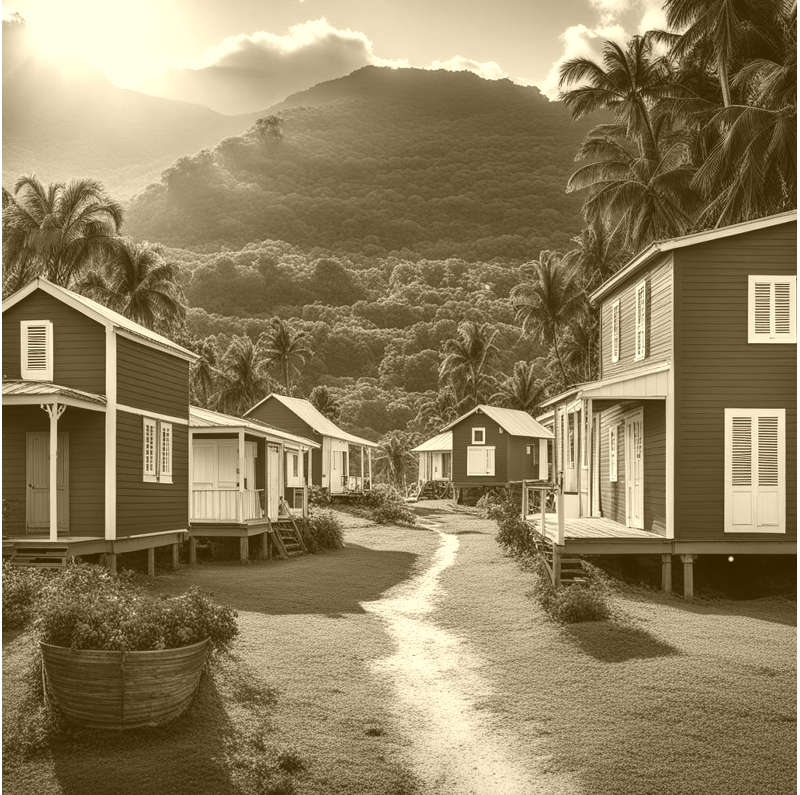
“‘What is this Theodosia?’ demanded Gwennoelle.
‘Why, Madame,’ The man bowed to her slightly. ‘It is a little town on the east side of the island. Very pretty place, with its own market, and lovely cottages, newly built and ready for newcomers like you. It’s where many of our workers live.‘”
The Island Council is especially proud of the “workers’” cottages that cluster around plantations throughout Theodosia, freshly painted in red and white and each with their own small vegetable plot. This housing is prominently pictured and described in advertisements for plantation workers in ports like New Orleans, Naples, and Dublin, their sturdiness and comfort extolled, along with the availability of schooling for children.
The heat, the uncovered cisterns, Yellow Fever, and the houses’ actual tenants are not mentioned.
One of the most prescient science fiction stories I ever read was written in the second half of the 20th century, well before the internet as we know it existed. In it, a terrorist has given the date and the time when he plans to destroy society. The future-cop protagonist naturally assumes this means some sort of weapon, a massive bomb, perhaps exploded on a subway or the center of a city.
In fact, all the terrorist does is take down the internet – not of course, called the “internet” in the story, but still, the internet. In that futuristic, science fictional vision of the 21st century, you see, everyone carries their own phone and everyone is in constant contact with everybody else. On the time and date predicted, that contact is cut off.
Chaos ensues. Businesses, transportation, government, the judicial system, public services, entertainment, the media, can’t function.
But more important than all that, neither can human beings. For the first time in their lives, people cannot communicate instantly with anyone other than other human beings who are within a few feet or yards from them.
The result is not pretty.


