If I’m very angry — which doesn’t happen often — I go for a long walk. If I’m frightened or sad, I’ll take refuge in a book or a computer game, or I’ll write a story. My novel was begun shortly after my father was diagnosed with the cancer that killed him. It was a place for me to go.
One way I have of coping is playing The Sims. There’s something calming about the overview it offers, watching characters go from infant to child to adult. Sims offer context.
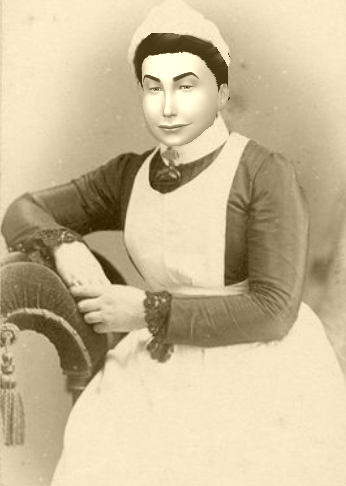
I’ve always made my Sims’ lives as realistic as possible. Some of them are pretty — most are not, or at least, they aren’t after they have hit adulthood, started having kids, gained weight, etc. Most just look ordinary, like the rest of us. (herewith, one of my favorite Sims — the formidable Laurette.)
Playing The Sims stimulates the part of the brain that tells stories. When I retire for the night, as I drift off, I can think of them instead of lying awake and pointlessly worrying about the state of the world.
Rain, or rather, a perpetually falling mist. Everything is blurry. The Golden Gate Bridge is invisible, our street a white ribbon rising up and getting lost in the flat gray page of the sky behind Pacific Heights. It’s almost muggy, and the air is still, breeding insects. Last night, after the wind dropped and the temperature rose, I killed a mosquito, squashed into a red spot against the living room wall.
The closing night party for the Film Festival was on Thursday evening at the Masonic Center. We walked up the steps past an alfresco patio and bar, which I could not imagine anyone using on such a bitter night, and into the large foyer where a live jazz band played and a few tables were set up. Sticks of sate, (no sauce), a table of sushi where we were only allowed on piece each. Another table of Joseph Schmidt truffles, another with a selection of cheese. I stationed myself at the cheese table with a plate and loaded it with wheat thins smeared with supermarket brie. There, I fell into conversation with a stocky, gray haired man from Michael’s Film club, then made my way to another table, this one with handrolls. I helped myself to three, some peanut sauce, and a Calistoga. Then I wended back to Michael.
We bobbed around in the foyer as the crowd grew and the band seemed to get louder and louder. A guy I’d dated briefly before Michael appeared in the crowd with a thin long-haired girl and pretended not to see me. (If he hasn’t changed, I have no doubt that as soon as I was out of sight, he was frantically hissing at her that there was someone present he had to avoid.)
The Masonic Center can be spotted in the 1968 Steve McQueen film BULLITT, its facade with its faux-Egyptian carvings visible in a scene shot from across the street at Grace Cathedral. I’d passed it frequently, but this was my first time inside.
Film Festival parties were all about schmoozing and schnorring. Hungry filmmakers, writers, critics and other movie folk would descend upon the tables and gorge themselves (ourselves) on the free food, holding up paper plates, chewing, casting our eyes about to see what was offered, in what quantities and where it came from. Conversations were frequently interrupted by friends with bulletins about a table offering sushi/handrolls/sate/truffles/gelato/lavash/dolmades/jello shots in the other room.
The old flame I saw was a moody, good-looking Scorpio who , every time we went out, spotted some ex-girlfriend in the restaurant/movie theater. He’d spend part of the date with his head down, hiding his face with one hand like a mobster walking from a courthouse past reporters. I haven’t seen him in years, either because he’s moved from The City or because he finally cut such a wide swath through Bay Area women that he can no longer go out at all.
I live two lives — one is here, and the other is on the Isle of Touperdu.
When I drove to Tim’s Berkeley office I found it empty except for a few boxes, partitions, moving men, and a handful of employees, one of whom told me she thought Tim might be helping “set up the lab” at Alameda. I got directions from her and drove down.
It’s not difficult to find in that it looks like a spanking new commerce center just off the tubes. Sun now has a building of its own, very modern, and upscale looking. All I could see out front, though were what looked like moving people. Several large women, one with tattoos up and down her arm, conferred with some tough looking men next to a pick-up truck with a little girl in the cab. I wandered into the building and inside I ound a maze of partitions and offices, marked with numbers and names.
Occasionally I’d bump into a workman. Finally, as I was passing, one spoke to me. “Know where I can call out for a pizza?” he asked. He was short, dark and powerfully built, and talked like he was from new York. I told him I was a complete stranger to the place and sked him if any Sun employees were around. “They’re in the back having a fuckin’ feast,” he said.
In the back I found a small semicircle of Sun employees sitting on the floor in a bare room, surrounded by munchies and beer. I only recognized two of them aside from Nat Goldhaber. When I asked about Tim, they said he wasn’t there. “Tim blew off two hours ago,” a dark, bearded man said with stiff disapproval. I went back out to my car, to drive home, smiled at the little girl in the truck, who smiled back. (She was a dark-eyed little thing, bent over a book.)
Tim and I had takeout sushi for dinner – then we went out to buy a couple of CDs. This time we went to a shop on Haight Street. It carried mainly records, but there were few racks of CD cards. The clerks were pretty avant-garde, one skinny with a dry thatch of bleached hair tinted green at the ends and a tight leather outfit jingling with jewelry and chains. The other was plump and British, with black wire glasses and a simple punk cut pulled back into a stiff, short ponytail. We bought the new Talking Heads album and Sinead O’Connor.
Tim at that time worked for TOPS, (Transcendental Operating System) which had recently been sold to Sun. I remember Nat Goldhaber, now listed in Wikipedia as “an American venture capitalist, computer entrepreneur and politician” as a pleasant, pink, oval-shaped man. His new age outlook would have meshed with Tim’s interest in the occult. In 2000, Nat was the vice-presidential nominee for the Natural Law Party.
Those Haight-Ashbury record-store clerks, whose clothes and appearance struck me back then, would not warrant a second glance today. The Talking Heads album was likely NAKED, the Sinead O’Connor her first, THE LION AND THE COBRA. Two of my favorites. I believe I still have them.
so there are many films I’ve seen more than five times, mainly classics — Citizen Kane, The Shining, The Big Sleep, Casablanca, Jaws, The Shining, Metropolis, Gone with the Wind, The Godfather I & II, The Seventh Seal, The Wizard of Oz, Fanny and Alexander…
A truly great film yields something new every time you watch it. Among the things I’ve noticed in most recent viewings:
In Citizen Kane, one of the most iconic characters, the loyal Mr. Bernstein (Everett Sloan), makes what I suspect is an oblique comment on the anti-semitism rife in the early 20th century. Most people remember him from the moment when he reminisces about a lost love he glimpsed only once on the Statin Island ferry. (“a white dress she wore…“). Every time I watch that scene I’m struck by how Sloan says the investigating reporter’s (William Alland) name. “Well, you’re pretty young Mr… Mr. Thompson…” The slightly skeptical emphasis makes me wonder if Bernstein is commenting on his supicion that Thompson is the anglicized version of a Jewish name.
In The Big Sleep, director Howard Hawks mercifully shot veteran actor Charles Waldron from behind when he had to utter one of the script’s more purple lines, General Sternwood’s comment on orchids. “Nasty things. Their flesh is too much like the flesh of men. Their perfume has the rotten sweetness of corruption.” (I blame Faulkner, who worked as a screenwriter on this film.)
In The Godfather I & II, the matriarch, Mrs. Corleone, is often thought of as the saintly moral center of the family. She has plainly been a good, affectionate mother to her sons, even the adopted Tom Hagan, but her treatment of her daughter, Connie, borders on uncaring. Especially revealing is a scene at the dinner table, (warning — the N word is used) where Mrs. Corleone is shot from the back as a sort of dark, looming presence. Connie’s abusive husband tells Connie to shut up and Sonny, the only family member willing to protect his little sister, tells him, “Don’t you ever tell her to shut up, you got that?” Mrs. Corleone raises one hand and says coolly, “Don’t interfere.”
SPOILER
Finally, as a bonus, I’ll point out something often missed in V for Vendetta, which has long been a guilty pleasure of mine. In the wonderfully edited dominoes falling scene, as Finch talks about what he sees happening. there is a glimpse of his and Evie’s future. In this video it’s at the 2.46 mark. Evie, with her hair grown out, is arranging a vase of Scarlet Carsons, and Finch can be seen as a reflection in the mirror behind her, sipping a drink.
Bonus trivia: As someone who read the original V for Vendetta comic when it was serialized in Warrior Magazine I can tell you that in the graphic novel, Finch gets his “feeling” by visiting Larkhill while under the influence of LSD.
DUB-DUB
“ There were the native fetishes called ‘dub-dubs‘ found buried or hidden in rocky niches, small wooden figures now heavy with the nails that had been driven into every inch of their surfaces. Like most gestures of despair, they still retained a little power, but the spirits banished from them were merely gray veils of sadness hovering over certain glades and beaches.”
We all like to imagine we aren’t superstitious. I enjoy a good ghost story, but they don’t keep me awake at night. In my teens, I was impressed with Ouija boards — until someone pointed out we were communing with the infinite using something manufactured by Parker Brothers. I collect and read tarot decks, but I think tarot spreads — and how someone reacts to them — are more likely to reflect a person’s inner life and expectations than the actual future.
Back in college, I used to perform cartomancy at parties, usually after a few drinks. At one, feeling especially confident (drunk) I decided to do a large, elaborate past/present/future tarot reading for a lesbian friend’s date. I had never met the date, who was a a rangy woman a little older than us, in her mid twenties, goodlooking, with long reddish hair. She sat on the sofa smoking a cigarette while I spread out the cards– probably Rider-Waite — on the cleared-off coffee table. Once I had laid them all out I sipped my drink, stared down at the spread, and tried to decide what to say.
Most of the time, you have to dig a meaning out of a spread, but in this case, the cards were absolutely, disturbingly clear. In her past were three men. All three had been important to her — lovers. All three had died violently.
Naaah. I couldn’t say that. So I didn’t. In my tipsy, befuddled way, I offered a generic reading about troubles in her past, but a better future, etc.
After I’d finished, She puffed on her cigarette, for a moment, her eyes on the cards. “I’m disappointed,” she said. “I though sure they’d say something about my three dead boyfriends.”
It turned out she was an ex motorcycle Mamma who’d had three biker boyfriends. Two had died in motor collisions, one after being shot. She’d decided after that she was a mankiller who should to stick to women.
I don’t recall my exact reaction, only being flabbergasted and alarmed, though I did have the presence of mind not to add to my humiliation by muttering “Oh, well, yes, of course I saw that,” as I gathered up the cards. For a long time afterwards, I remembered this as my own brush with The Unseen.
It took years for a very simple thought to occur to me.
Other people can read tarot cards.
By late afternoon I was back at Kings Cross. I wanted to check my email, and I’d noticed a library branch just down the road from the hotel. It proved to be a typical inner city library, upstairs in a storefront, a single floor of books rather bare bones, but there was a space on the mezzanine that offered free WiFi. Every chair in the little room with the table was taken, so I sat in the waiting area and turned on my Ipad.
“Excuse me.” I looked up. A tall man with a shaven head was standing beside me. He wore a white shirt, a tie, and dark slacks. “You speak English?” he asked, with a slight foreign accent.
“Yes.”
“Could you please look at my letter. I have a letter. There.” He gestured back at a computer. “And it must be correct. Could you perhaps look at it and correct?”
I could think of no reason to refuse, so I walked over to the empty chair he indicated and sat down in front of the computer.
My default, probably unfair assumption when I get a request like this in a public space is that the person asking for help is cracked. Maybe he was, but it wasn’t evident in the letter, which, though long at eight paragraphs, was fairly well organized and scanned logically in spite of a few errors in punctuation and syntax. It seemed to involve some legal dispute about benefits he felt he was owed. There was none of the sulpherous rage I associate with crazy people’s letters, though there was a sprinkling of irritation over points he felt he’d already gone over in an earlier letter. Of course, it could all have been bullshit. If I actually knew what was going on, I might read it and shake my head and say, “this guy is nuts.” Who knows? I made the corrections and then, after the file was saved, he offered me the computer. I could use the rest of his time if I wanted, he said. I explained that wasn’t necessary, that I had an Ipad, and he thanked me profusely again. I returned to my chair in the waiting area and updated my email.
My western astrology sign is Scorpio, but nobody likes to compare themselves to an arachnid. In Asian astrology, I was born in the year of the dog, and that never bothered me much, so perhaps that’s the answer.
One of my very early memories is the moment I realized, no matter how hard I pretended, I could not turn myself into a dog and go trotting around the neighborhood having adventures with our spaniel. I must have been about two or three, and sat under the kitchen table feeling my face and realizing I could not get it to grow into a muzzle. Very disappointing.
Our first Zoom event at work last night. We had ninety reservations and roughly sixty people showed up. I’m becoming comfortable managing a Zoom meeting, though I miss being there, standing in the back of the room, watching the audience, hearing the sound of laughter and claps. In a way, this was a leap back to when I first started my job seventeen years ago. Back then, before automated reservation systems, I had to handle every reservation via phone-calls and emails. Now I’m sending out Zoom links to every attendee, and keeping track of the list all the way up to the minute of the event. Looks like I’ll have to return to my old habit of doing follow up calls/emails on the morning of the event asking reserved attendees to notify me if they can’t show up, so I can make room for people on the waiting list.
So, events online are both more personal and more impersonal. I must interact directly with every member one way or another, and when they show up, just before I turn off the camera, I often catch glimpses of tiny corners of their homes, a sofa, a picture on the wall, a book-case.
We need to do laundry today. It’s been piling up, and while Michael handles that downstairs at the laundromat, I’ll be cleaning out the refrigerator. When you spend the majority of your time in one living space, never going out, but moving constantly from room to room, opening and closing the same cabinets and closets, it leaves deeper, grottier tracks.
I think the cat is losing patience with us. Not only is she retreating into the bedroom beside the radiator in the afternoons, she’s begun holing up under the bed and unplugging our bedside lights. Our bed is one of those platforms that sits flush on the floor except under the headboard, where there’s a narrow passage, so once she’s under there, it’s hard to get her out. It’s also a pain in the ass to plug the lights back in, because it involves pulling back the mattress, folding back the slats of the platform, and lying full length on the frame, craning to see the plug. If it happens after dark, forget it. I’ll be reading in bed with a flashlight. This morning at about 6:30 am we had a battle of wills in which, after stomping repeatedly across us to wake us up for kibble, she burrowed under the bed and began thumping around because she knows if I hear that, I won’t pretend to be asleep any more but will roll over on my back yelling her name.




 Pam Troy