We all went home earlier than usual, at about 5:00 PM, to get ready for the party. Woody called us at 6:50 to tell us that, because of a backup on Sacramento, he’d meet us at Hyde and Clay. We found him standing beside his BMW. Woody is a rather good-looking fox-faced man in is thirtes, with a goatee and a bald, possibly shaven head. He was dressed very snappily with a white shirt and dark tie that made me think he was wearing a Tuxedo until I saw his colorful, gold-colored vest. His girlfriend, Dominique, is a tall, frond-like dancer, very delicate featured, with long blond hair.
The drive to the Golf Club was lengthy. I sat in the back and watched neighborhoods spin past, Polk Street, the Tenderloin, Van Ness, Lombard, all the way out to the neighborhoods near the Panhandle with the rows of stuccoed houses. Woody talked to Michael about real estate and the wonderful things Mayor Giuliani had done in New York City. I was too carsick to say much of anything except to ask Woody, after he’d expounded about how MAGNIFICENT New York is now, if anyone could afford to live there. He allowed as how it was a bit expensive, then went on about how concerned he was about certain liberal elements in San Francisco’s current city government, and the possibility of a mass exodus if they pass any no-growth measures. I refrained from observing that there has already been a mass exodus of the middle and working class over the past ten years, but it took an effort. I did demur once, pointing out that, after the Amadou Diallo shooting, I doubted black New Yorkers felt safe walking there at night, but Michael changed the subject and I fell back into sullen silence.
The conversation turned to the much more congenial subject of Dickens. Woody is taking part in a local festival where people wander about playing characters from Dickens — rather like Ren Fair, another institution Woody is involved in. (That was how he met Dominique — through sword fighting at Ren Fair.) Woody is going to play half of the two gentlemen who visit Scrooge asking for “some provision for the poor.” We traded Christmas Carol quotes until he pulled into the long, elegant driveway of the San Francisco Golf Club.
I suggested we go see Beetlejuice, which was playing between Fifth and Sixth. “I don’t think there’s any theater around here we want to go to,” Tim said, but I convinced him. The previous movie, Friday the 13th Part 7, was still playing, so we had to wait in the tiny lobby until it was over. The theater was almost full when we did go in, so I guess everyone had paid for both features. We ended up way up front, in the fourth row.
The audience was rowdy, but not menacing. The theater looked as old as it’s name “The Electric”, suggested. There were roccoco reliefs on the walls of effete young men in Roman dress, and holes and stains on the ceiling.
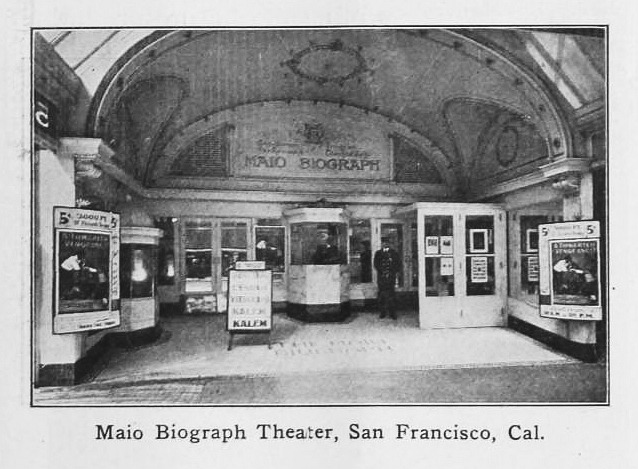
“The Electric” did, indeed, date back to the silent era, but its namewas relatively new. According to this website, the theater started as the Maio Biograph, then the Circle, then the Newsreel, then the Crest, and only after that, the Electric.Now it’s The Crazy Horse “Gentlemen’s Club.”
It was the movie theater closest to where we lived, practically around the corner, on a section of Market that was profoundly run down and depressed (it still is.)Most of the people attending were likely neighbors, but not our closest neighbors, not on Tehama, which back then was being settled by 20-something artists and Silicon-Valley Gold Rushers. I remember the audience as, not older than we were, but wearier and in older clothes.
The “rowdiness” of the audience was the kind I like, which involved comments about the action, loud expressions of approval and disgust, and occasional instructions yelled at the characters.
This is not a review of the new Apple series by Vince Gilligan, though if it were, it would be a good one. Rhea Seehorn’s performance, the writing, the cinematography, the sound track, all of it is excellent. But this piece is less about the show than about the reaction to its lead that I’ve seen from commenters online.
Especially male commenters.
So, be warned, here be monsters in the form of, not only a feminist perspective, but spoilers. If you haven’t watched this so far smart, wonderful science fiction series and would rather go into it clean, stop reading now.
Plur1bus could be described as yet another post-apocalyptic zombie series, except that the zombies, instead of groaning and lunging at non-zombies, smile a lot and ask how they can help. In the first episode the main character Carol Sturka (Rhea Seehorn), a wildly succesful romantasy author, witnesses a zombie takeover. It arrives in the form of an extra-terrestrial infection that, for a few minutes, freezes most of humanity into twitching, rigid convulsions. The resulting chaos — head injuries, blood loss, car and plane crashes, fires, drownings, etc. — kills millions, including Carol’s wife. When it’s over, all of the remaining human population on earth, except for a handful of the immune, have been melded into a single hivemind.
A very happy hive-mind, Carol is told, and one that insists it has her best interests at heart. She’s assured that all the combined intellects of Earth’s scientists will be working hard, from that night on, to figure out what went “wrong” and how they can get her and others like her to join them.
Whether she wants to or not.
Carol’s fight against this “benign” agenda is complicated by the fact that, if she loses her temper and yells at an individual body in the hivemind, the whole hive once again freezes worldwide for several minutes. This results in more car and plane crashes, injuries, etc, and millions more deaths, all of which are blamed — by many of the other unassimilated humans and quite a few viewers — on Carol. A form of emotional blackmail familiar to most women is thus writ large.
Which makes Plur1bus a fascinating examination of how even the most clear-eyed, justifiable female anger is treated as a pathology. It’s practicaly a Rorscharch test revealing how many male viewers — and some female viewers — react to persistently uppity women.
So far I have seen Carol described as “damaged,” “fighting inner demons.” ” and “her own worst enemy.” She is, some viewers have commented, “self-absorbed.” “narcissistic.” And, of course, she is a “Karen.” (I suspect writer Vince Gilligan chose her name for its similarity to that term.)
There is little indication she is any of these things. True, it’s established early on Carol has a drinking problem that resulted in a breathalyzer being installed in her car, but if she’s an alcoholic, she’s a functional one. At a book reading in the first episode she handles herself beautifully, interacts with her fans with grace, courtesy, even kindness. Only after she’s left the event do we learn Carol is bitterly unhappy with the direction her career has gone and considers her successful fantasy series “mindless crap.” Once everything falls apart, and she finds herself the only person in the United States who’s not been assimilated, she goes on a brief binge of drinking and watching DVDs of Golden Girls, but hey, who wouldn’t? (She’s had to bury her wife in the back yard, for God’s sake.)
By the end of the fifth episode, Carol has displayed every aspect of a heroine. She is smart, resourceful, compassionate, and profoundly principled. Her fury at the hivemind is not merely because of its impact on her own life, but because it has robbed the humans around her of agency. In one especially telling episode, she prevents a woman in the hivemind from being used by an unassimilated man who sees the passivity of the hivemind bodies as an opportunity for sexual gymnastics.
And yet, I keep hearing Carol described as “unlikeable,” and her attempts to fight back against the eternally smiling hive denounced as “out of countrol”, vicious, mean, etc. The force that resulted (according to the script) in almost a billion human beings dying is, some viewers have speculated, actually the good guy because it’s erased all racism, crime and warfare. Carol’s attempt at learning the truth by drugging one member of the hivemind and inadvertantly causing a dangerous heart attack is, on the other hand, cited as proof that Carol is the true villain.
Why can’t she just be nice?
I can’t say for certain what direction this series will go, but I am reasonably sure of one thing. No successful 21st century screenwriter is going to promote a story with the moral being “this angry lesbian needs to calm down and relax and enjoy being assimilated by a hivemind.”
It’s possible, I suppose. This is, after all, the Age of Trump. I may be wrong.
But I doubt it.
Abstract noun: A state of adequacy or legitimacy within an imaginary environment.
“His cromulence as a marathon runner filled him with pride in his recurring dream.”
Also: The pretense that something sounds legitimate when it plainly is not.
“The cromulence of advertising popcorn flavored jello.”
The Conversation, 1974 A tense film about privacy and paranoia that morphs at its climax into borderline horror. Gene Hackman is a character he reprised years later in Enemy of the State, a very young Harrison Ford appears in a small but important role, and Robert Duvall has what amounts to a cameo. If you can watch it without clenching either your fist or your knuckles in certain scenes, you have stronger nerves than I do.
It’s a Wonderful Life, 1946 Yes, everyone has seen this movie a hundred times, but here’s what people miss about it — It’s not just about the impact a single man can have on the people around him. It’s about the passage of time, about being alive in the early 20th century. People often overlook how much the film was aimed at middle-aged people in 1946 and all they had seen in their lives. The historic touchstones studded through it include the Spanish Flu epidemic, the Jazz age, Black Monday and the Great Depression, the rise of the automobile and, of course World War II. Then next time you watch, keep an eye on the sets — the banner at the High School dance (“Class of 1929”), the picture of Herbert Hoover on the wall of the Savings and Loan… Also keep in mind that Stewart himself was still suffering from PTSD from his active service during the war.
Chinatown, 1974 This neonoir set in 1930s Los Angeles, is, on the surface, a thriller about water-theft and graft but by its end becomes a stark meditation on conscience in the face of powerful, entrenched evil. (And yes. I mean “evil.”) Fantastic performances by Jack Nicholson, Faye Dunaway, and especially John Huston.
A Night to Remember, 1958 Forget Titanic. A Night to Remember, a docudrama based on Walter Lord’s book, is more heartfelt and does more more without color, CGI, or melodramatic nonsense about a lost jewel and forbidden love. Most of the stories it depicts are true, based on eyewitness testimony, and therefore far more compelling. I was left dry-eyed by Titanic. The moment in A Night to Remember when everyone on the sinking ship begins to pray never fails to hit me hard.
Shadow of the Vampire, 2000 In this blend of horror and satire, John Malkovich plays the great silent director F.W. Murnau and Willem Dafoe plays the vampire. Murnau is filming Nosferatu and, unbeknownst to the actors and crew, has cast the real thing in the title role. Never has a temperamental and demanding star done more damage on the set. “How dare you destroy my cinematographer!” Murnau shouts, shortly before his film’s lead smugly observes that they don’t really need the writer anymore.
French Cancan 1954 Imagine a sumptuous Hollywood musical without the Hays Code. That’s Renoir’s French Cancan, a lively, fictionalized retelling of the revival of the French Cancan at the Moulin Rouge in the 1880s. The heroine, a young laundress, casually loses her virginity within the first half hour of the film, then spends the rest of it concentrating on her dancing. (I believe this movie just might pass the Bechdel test.) The climax of the movie, the Cancan’s re-introduction at the newly opened Moulin Rouge, can be enjoyed on a device, but truly should be seen on a big screen. That scene alone would be worth the price of admission.
Carnival in Flanders, 1935 The plot is simple. It’s 1616, during the Spanish occupation of Flanders. A small Flemish town is preparing for its carnival when news comes of a Spanish duke and his entourage coming through. Fearing pillage and rapine, the mayor decides to play dead and the men go into hiding, while their disgusted wives choose to greet and welcome the visitors. The result is a funny, frequently biting film about the women running the town and having a helluva good time with the Spaniards. (I recommend the crisp Criterion copy, and not the older version of the original American release, which has bowdlerized subtitles.)
The Great Dictator, 1940 This film about the Nazis made its contemporaries uncomfortable. They felt Hitler was not a good subject for satire. It is now seen as one of Chaplin’s best. Charlie Chaplin plays a double role as both a poor, shell-shocked Jewish veteran of WWI, and the ruthless, anti-Semitic dictator of Tomania, Adenoid Hynkel. Excellent satire about anti-Semitism, media, and class — especially when the Jewish barber joins forces with a brave-but-cluelessly-entitled German aristocrat who opposes Nazism. Most famous now for Chaplin’s closing speech as the unnamed Jewish veteran disguised as Hynkel. Which brings us to…
Schtonk, 1992 Those of us old enough to remember the wall coming down also may remember the Hitler Diaries scandal in the early 1980s, which fooled Hugh Trevor-Roper, Stern, and The Sunday Times before being exposed, not only as a forgery but a bad forgery. Schtonk, is a blackly funny German satire about the scandal that makes Mel Brooks’ The Producers look like a heartwarming family comedy. (“Schtonk!” is an exclamation in the imaginary language of Tomania from Chaplin’s film.)
Look Who’s Back, 2015 Hitler has been inexplicably resurrected in 21st century Berlin — and not the addled, Parkinsons-afflicted old man of 1945, but the younger sharp-witted version who became chancellor in 1933. He quickly susses out where he is and adjusts, while Berliners assume he’s merely a performance artist who never breaks character. Though he never denies who he is, he soon achieves a frightening level of celebrity. One of the best scenes involves Hitler meeting an elderly survivor of the camps, a woman too far gone in dementia to doubt who or what she is seeing. She reacts, not with amusement, but with gratifying rage and contempt.
…that people travel thousands of miles to visit. I love its cafes, its restaurants, its museums and bookstores and libraries. I love its outlook. I love riding its public transit, walking up and down its hills, strolling alongside the bay. I have lived here longer than I have lived anywhere else.
…like “curate” (for anything other than actually managing the collection of a museum or gallery) or “strategy” (for anything other than public policy, gaming, or military tactics) or “problematic,” (for anything not 21st century liberalism,) or “woke” (when used by either the right as an insult or the left as a self-congratulatory badge).


 Pam Troy