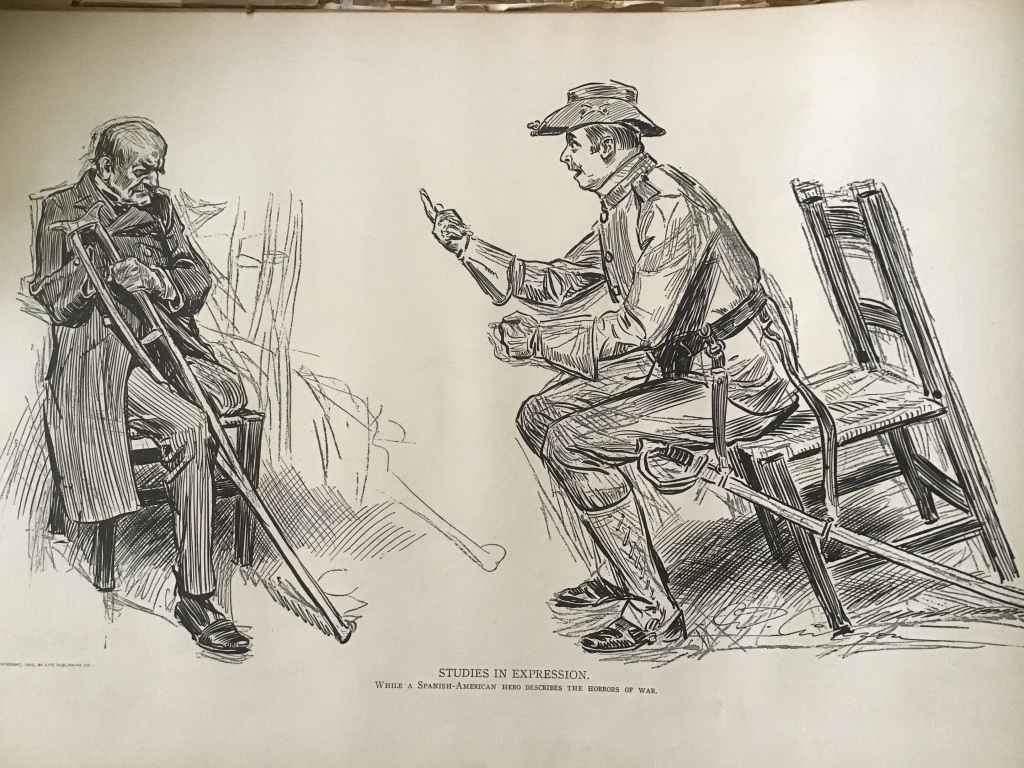
I came upon this while going through a stack of old books. Charles Dana Gibson is remembered mainly as creating the “Gibson Girl,” the embodiment of the tall, beautiful, athletic and independent American girl. You’ve likely seen his drawings of young, beautiful women, even if you don’t know his name. But he was also an excellent illustrator, who could tell a complex story with a single frame. One of his better series was “Studies in Expression.” Unlike his Gibson Girls, this series often focused, like this one, on the grittier side of life in the late 19th, early 20th century.
The caption, if you can’t read it, is “While a Spanish-American Hero Describes the Horrors of War.” The 1898 Spanish American War is still sometimes referred to as “Hearst’s War,” after newspaper mogul William Randolph Hearst, whose papers launched a propaganda campaign against Spain. Ostensibly it was to help Cuba gain independence, but really the U.S. sent in troops at the behest of American business interests who wanted the conflict to end. It was, to put it bluntly, an American territory grab in the Caribbean.
In 1902, when this was published, Gibson’s audience would have surmised the figure on the left as a veteran of the Civil War, based on his age and the fact that he is a double amputee. His expression of contempt as he listens to this husky, intact young man describe the supposed “horrors” he’d experienced says a lot about what Gibson thought of Hearst’s War.
 Pam Troy