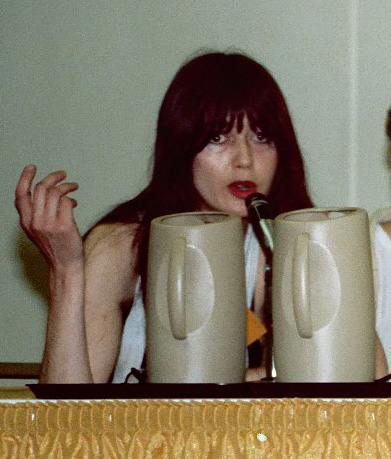
Photo by Alan Light via Wikimedia Commons
I swear I am not deliberately posting a cluster of diary entries about deaths. This is just the order of the entries.
Tim and I drove to Berkeley to eat before I dropped him off at work. We stopped first at Comic Relief on University, which had a new issue of Love and Rockets. As we were leaving, we noticed a copy of Dori Seda’s Lonely Nights mounted in a plastic frame, and a rose beside it with the words, “In memory of Dori Seda.”
We turned around and went back in.
Unfortunately, the woman we are friends with had gone into the back to work on taxes and was replaced at the desk by a young man we didn’t know who wasn’t very forthcoming. “Oh Dori Seda died,” he said.
“How?”
“I don’t know. Complications. She was in a car crash.”
We walked out, shocked. Just a couple of months before, we’d met Dori Seda at a party Comic Relief had held. She was a tall artiste with a mane of frizzy brown hair, a round bunny face and a space between her front teeth. It’s a cliché to say of a well-known person “I felt as if I knew her,” but I did. Her work was always so funny and ribald, and it felt familiar.
No, Dori Seda did not die from a car crash. She died, far too young, from a bad bout with the flu, her lungs undermined by the silicosis she’d contracted when she worked in ceramics. Seda’s art was so good that, a few years after she died, I talked with someone for several minutes at a Bay Area party while wondering how I knew the man. I had seen that face, and I was sure he must be an old friend.
In fact, we’d never met. He looked familiar because, as a friend of Dori Seda’s, he’d appeared frequently in her comics.
I loved the humor and realism of her art, which was so unlike many female cartoonists at that time. Women underground cartoonists too often depicted being a woman as being grotesquely self-hating — which I suspect is how many male publishers of underground cartoons imagined us. Seda was good-looking, and she drew herself that way — along with all that went with being an attractive woman in a circle of male artists and cartoonists who had come of age in the sixties and seventies.
One of my favorites of her panels was a door-frame view of an angry guy she’s just brushed off. He’s holding a six-pack in one hand and raising his middle finger in the other, just before she closes the door on him. The caption reads “Pissed cuz he didn’t get laid.”
Which I’m afraid summed up so many men in the ’80s when you were young, female, and cute.
 Pam Troy